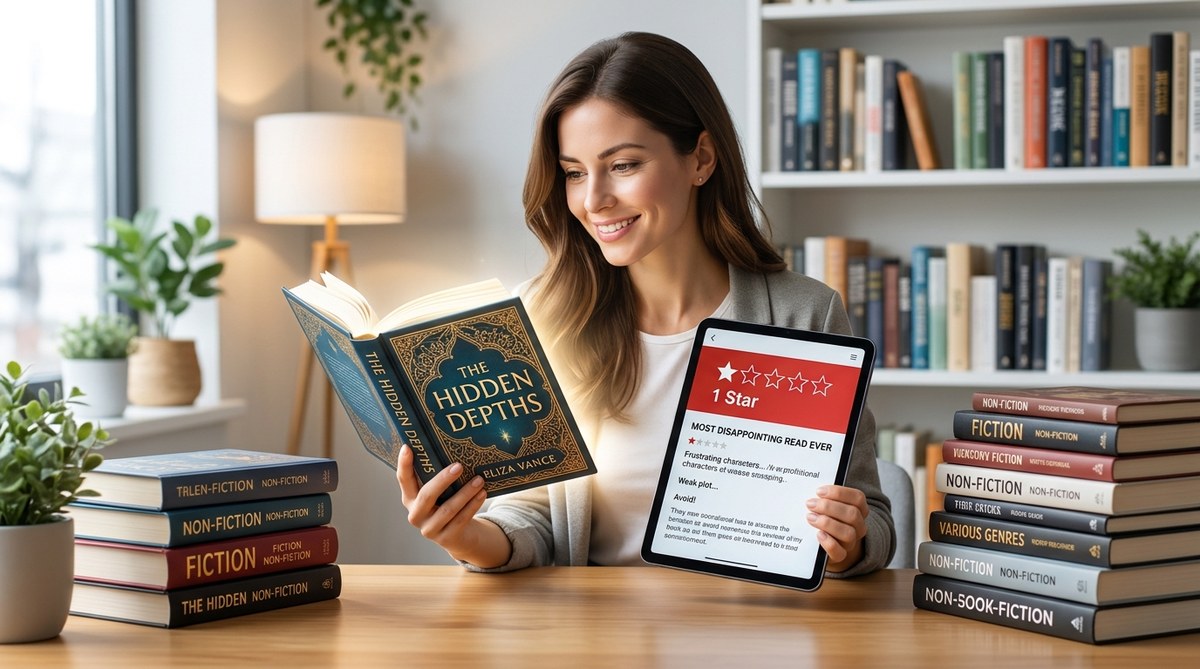
The Surprising Reason You Should Read the Worst Review of a Book First
Most people scroll straight to the five-star praise. They want to be sold on a story. They want to see the glowing quotes that promise a life-changing read. But the smartest readers do the opposite. They hunt down the one-star and two-star reviews first. It sounds counterintuitive, but reading the worst critique of a book before you commit is one of the most effective ways to decide if a novel is actually for you. A bad review tells you what the book is not. And sometimes, that information is more valuable than all the praise in the world.
Reading the worst review first helps you understand a book’s specific flaws before you get caught up in hype. It reveals pacing issues, writing style clashes, or content problems that would bother you personally. This method filters out books that look good on paper but would waste your time. You stop relying on average star ratings and start making smarter, faster reading decisions.
The Hype Filter Is Broken
We have all done it. A book appears on every “Best of 2026” list. Your favorite influencer posts a photo of it on their nightstand. The average rating is a shiny 4.5 stars. So you buy it. And two chapters in, you realize you hate it. The writing feels clunky. The protagonist makes choices that drive you crazy. The pacing is slower than a Monday morning.
The problem is that average ratings flatten everything. A 4.5-star book might be a masterpiece for 90 percent of readers. But if you fall into the 10 percent who cannot stand purple prose or slow-burn mysteries, that rating means nothing to you. The worst review, however, speaks directly to that 10 percent. It tells you exactly why someone hated it. And that specificity is your best tool for making a choice.
Why a Bad Review Is More Honest Than a Good One
Think about how most people write reviews. When someone loves a book, they often gush. They say things like “I could not put it down” or “This changed my life.” Those are emotional reactions, not critical evaluations. They do not tell you much about the book itself.
When someone dislikes a book, they get specific. They complain about the pacing. They point out plot holes. They mention that the dialogue felt unnatural. They explain why the ending let them down. This kind of feedback is gold for a skeptical reader.
“A negative review is not an attack on the author. It is a report from a reader who paid attention. If they took the time to write three paragraphs about what went wrong, you can trust that they read the book seriously.” — Anonymous librarian, 2026
That specificity lets you compare their complaints to your own preferences. If a reviewer says “the world-building was too detailed and slowed the story,” and you love rich, immersive settings, that bad review just told you the book is perfect for you. If they say “the romance felt rushed,” and you hate insta-love, you just saved yourself a purchase.
How to Read a Bad Review Like a Pro
Not all negative reviews are useful. Some are just venting. Some are based on a misunderstanding of the genre. Some are written by people who clearly did not finish the book. You need to separate the signal from the noise.
Here is a simple process to follow:
- Sort reviews by lowest rating first. Most platforms let you do this with one click.
- Scan the first three one-star reviews. Look for patterns. If all three mention the same problem, it is real. If they all complain about different things, the book might just have a few haters.
- Check the reviewer’s other ratings. This is crucial. If the reviewer gives one star to everything, ignore them. If they have a balanced history and clearly disliked this book, pay attention.
- Look for specific, not emotional, complaints. “This book was boring” is useless. “The middle 200 pages had no plot movement and the side characters disappeared” is useful.
- Ask yourself if the complaint matches your taste. A complaint about “too much dialogue” might be a positive for you if you love character-driven stories.
The Surprising Reason This Works So Well
Reading the worst review first forces you to confront the book’s weaknesses before you are emotionally invested. When you read the five-star reviews first, you build up a fantasy version of the book in your head. You imagine the perfect reading experience. Then when you hit a flaw, it feels like a betrayal.
When you read the worst review first, you set a realistic floor. You know exactly what could go wrong. You go in with your eyes open. If the book is better than the worst review suggested, you are pleasantly surprised. If it is exactly as bad, you were prepared.
This method also protects you from the bandwagon effect. When a book has thousands of positive reviews, it is easy to assume it must be good. Your brain takes a shortcut. “So many people liked it, so I will too.” The worst review breaks that spell. It reminds you that no book is for everyone.
What a Bad Review Can Teach You About Yourself
This is the hidden benefit of reading negative feedback. Over time, you start to notice patterns in the complaints that bother you. Maybe you always agree with reviewers who hate slow pacing. Maybe you always disagree with reviewers who complain about complex characters. You start to build a personal “reviewer profile.”
Once you know your own taste, you can find reviewers who share it. If a specific reviewer consistently hates the same books you hate, their five-star recommendations become gold. You can skip the average rating entirely and just follow that one person.
This is why many experienced readers recommend building a personal list of trusted reviewers. You can find them by paying attention to the negative reviews that resonate with you. The 5 signs a book review is worth your time often include a willingness to be critical. A reviewer who only gives five stars is not helping you. A reviewer who gives two stars with detailed reasoning is a treasure.
Common Mistakes When Reading Negative Reviews
Not all negative reviews are created equal. Some are traps. Here is a table that shows the difference between useful and useless criticism.
| Useful Negative Review | Useless Negative Review |
|---|---|
| “The pacing dragged in the second act. I lost interest around page 250.” | “This book was trash.” |
| “The main character made decisions that felt out of character based on her backstory.” | “I hated the main character.” |
| “The prose was overly descriptive. If you prefer lean writing, skip this.” | “Too many words.” |
| “The ending felt rushed and unresolved. I wanted more closure.” | “The ending was bad.” |
The useful reviews give you data. The useless ones give you opinion. You want data.
When to Ignore a Bad Review Completely
There are times when a negative review should be ignored. If the reviewer clearly did not understand the genre, their opinion is less valuable. Someone who hates fantasy tropes should not be reviewing a high fantasy novel. Their complaint about “unrealistic magic systems” is irrelevant.
You should also ignore reviews that are clearly written in bad faith. Some people leave one-star reviews because of a personal grudge against the author, a shipping delay, or a price dispute. These have nothing to do with the book’s quality.
Finally, ignore reviews that complain about things that are clearly stated in the book’s description. If the blurb says “slow-burn romance” and someone leaves a one-star review saying “nothing happens until page 300,” that is on them, not the book.
How to Use the Worst Review to Choose a Book for Someone Else
This method is especially useful when you are picking books for other people. If you are a parent choosing a book for a child, a bad review can tell you things the positive reviews will not. It might mention mature content, difficult language, or themes that are not age-appropriate.
For example, a parent looking for a book for their teenager might read a negative review that says “the protagonist drinks at parties and the book does not punish her for it.” That information is critical. It is not a judgment on the book’s quality, but it is a judgment on whether it fits your family.
The best teen book reviews to inspire young readers often include this kind of detail in the negative feedback. Parents who only read five-star reviews miss out on these warnings.
A Practical Checklist for Your Next Book Decision
Before you click “buy,” run through this checklist.
- Read the worst review first. Write down the specific complaints.
- Read the best review second. Write down the specific praises.
- Compare the two lists. Do the complaints bother you? Do the praises excite you?
- Check the reviewer’s other reviews. Is this a trusted voice?
- Make your decision based on the data, not the star count.
This process takes about five minutes. It can save you hours of reading time and twenty dollars on a book you will abandon.
Why This Matters More in 2026
The book market is bigger than ever. More authors are publishing. More books are competing for your attention. The hype machine is stronger than ever. Algorithms push popular books to the top, regardless of whether they fit your taste.
In this environment, the worst review is your anchor. It keeps you grounded. It reminds you that popularity does not equal compatibility. It gives you a tool to cut through the noise.
The 7 book review habits that will transform your reading list in 2026 all start with the same step: stop trusting the average. Start trusting the details.
The One Thing to Remember
A bad review is not a warning. It is a filter. It is a tool that helps you sort books into two piles: “books I will probably like” and “books I will probably dislike.” It is not a judgment on the book’s worth. It is a judgment on the book’s fit.
When you read the worst review first, you are not being negative. You are being smart. You are protecting your time and your money. You are reading with intention.
So next time you see a book with a 4.8-star rating and a handful of one-star reviews, do not skip the one-star reviews. Click on them. Read them. See what they say. You might discover that the book is perfect for you. Or you might discover that you just dodged a bullet.
Either way, you win.