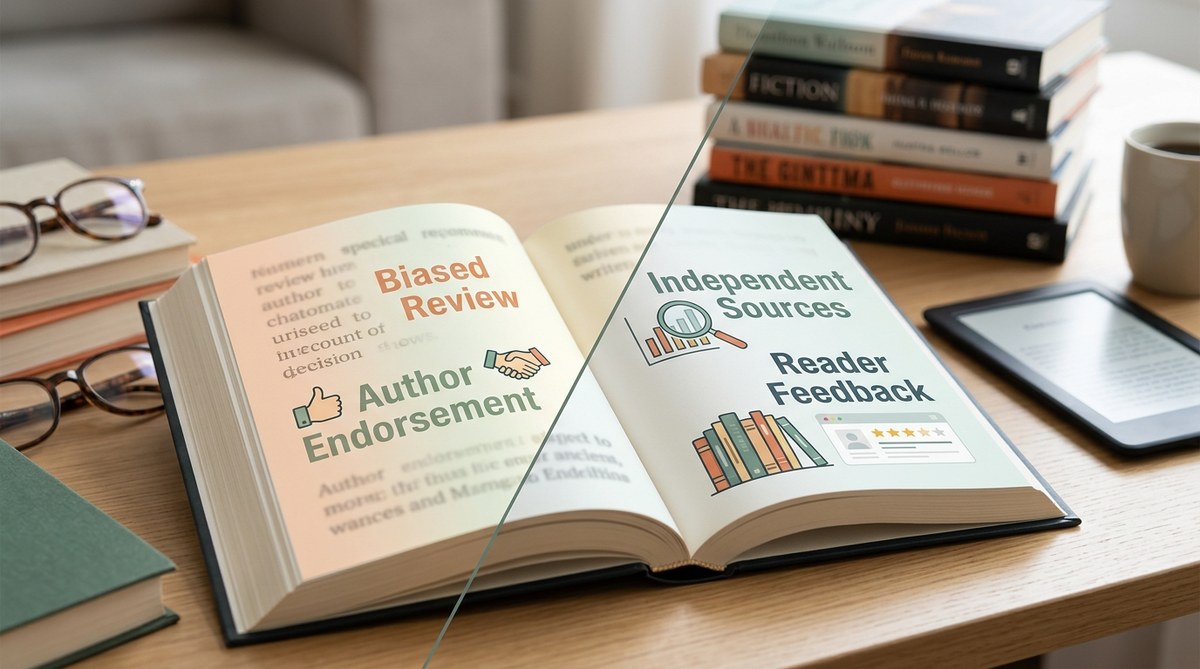
Why Book Reviews from Your Favorite Authors Might Be Biased (And What to Read Instead)
You pick up a book because your favorite author gave it a glowing blurb. The cover boasts a quote from a writer you trust. But after finishing the story, you wonder: did that author actually read the book, or was it a favor for a friend? If this scenario feels familiar, you are not alone. Many avid readers now suspect that popular authors and publishers quietly shape the reviews we see. The truth is, biased book reviews are more common than most people realize. And if you rely on them to choose your next read, you might end up disappointed.
Biased book reviews come from authors trading favors, publishers inflating ratings, and affiliate marketing incentives. To find honest opinions, look beyond star ratings and check for patterns like vague praise or all‑positive language. Use reader communities and cross‑reference multiple sources. Free yourself from the influence of marketing and discover books that truly match your taste.
Why Trusting Author Blurbs Might Lead You Wrong
Authors are people too. They have friends in the industry, owe favors, and hope for reciprocal endorsements. When a famous writer calls something “the best novel of the decade,” ask yourself: did they get an advance copy and a nice dinner? It is not malicious. It is just how the business works. But it creates a system where praise flows between colleagues, not necessarily based on genuine admiration.
Publishers also run “blurb swaps.” One writer agrees to compliment another’s book in exchange for a similar favor later. These deals rarely appear in fine print. The result is a stack of reviews that look authentic but lack critical distance. For a reader trying to decide between two new releases, this kind of bias hides the flaws that might matter to you.
How Publisher Networks Shape the Reviews You See
It is not only blurbs. Publishers maintain lists of reviewers who give favorable coverage in exchange for early access, swag, or advertising dollars. Review sites that accept payment for placement (even under the table) often rank books higher than they deserve. This is especially true for big‑name authors with big marketing budgets.
In 2026, the problem has grown because of “influencer” culture. BookTubers and BookTokers receive free copies and sometimes payment to review a title. Their income depends on staying in publishers’ good graces. Few disclosures are clear. So, when you see a 5‑star review from a popular personality, remember that their paycheck might come from the same house that published the book.
Common Signs of a Biased Book Review
Learn to spot the markers of bias. Use this table as your reference.
| Red Flag | What It Looks Like | Why It Matters |
|---|---|---|
| Vague praise | “Amazing story!” or “Couldn’t put it down!” without specific details | Real reviews mention plot, pacing, characters, or style. |
| No criticism | Every point is glowing, even in a “balanced” review | Honest reviews usually have at least one critique. |
| Same network repeats | Multiple reviews from authors who share an agent or publisher | Suggests a coordinated campaign. |
| Overuse of superlatives | Words like “masterpiece” or “brilliant” in every paragraph | Genuine praise is more measured. |
| Reviewer never reads the genre | A romance specialist gives a 5‑star review to a hard‑science novel | They may not know the genre standards. |
| Affiliate link overload | The review includes a buy link for every book mentioned | The reviewer earns commission, so they have incentive to make every book sound great. |
When you catch one of these signs, treat the review with caution. Cross‑check it against opinions from readers who have no financial stake.
A 5‑Step Process to Find Unbiased Reviews
Follow this method to cut through the noise and locate honest feedback.
-
Start with reader communities, not author platforms. Go to places where readers talk freely, like Goodreads groups (but beware of sock puppets) or Reddit’s r/books and r/suggestmeabook. Look for threads where people argue about a title, because disagreement usually signals genuine opinion.
-
Read the 1‑star and 2‑star reviews. Yes, negative reviews often reveal the most. They point out weaknesses that a fan would ignore. If the same flaw (slow middle, flat ending) appears in many bad reviews, take it seriously.
-
Check the reviewer’s history. A quick glance at a reviewer’s past ratings tells you if they normally love everything (untrustworthy) or mix high and low scores (more credible). On Amazon, sort by “most recent” and scroll through a few pages.
-
Look for neutral sources. Professional review outlets like Kirkus, Booklist, or Library Journal employ trained reviewers. While they are not perfect, they have less personal stake. Also try https://booksandstuff.info/10-book-review-sites-every-reader-should-bookmark-in-2026/ for a curated list.
-
Ask other readers directly. Post in a book club or forum: “Is [title] really as good as the blurbs say?” Real people often give honest answers without marketing pressure.
Where to Look for Honest Opinions Today
Here are reliable places to gather unfiltered perspectives.
- Library staff picks. Librarians read widely and have no incentive to inflate ratings. Many libraries publish “staff favorites” lists online.
- Independent bookstores. Their staff reviews tend to be sincere because they want repeat customers, not publisher favors.
- Reader‑driven review platforms with moderation. Sites that require a purchase verification (like Amazon’s “Verified Purchase” tag) reduce fake reviews, but not completely.
- Niche blogs and podcasts. Small, dedicated reviewers often have deep knowledge and no conflict of interest. Search for “book review podcast [genre]” to find them.
- Community‑curated lists. Sites like The StoryGraph let you see what friends or like‑minded readers are enjoying. You can filter by mood and pace, which helps bypass hype.
The Role of Reader Communities in 2026
Social media has changed how we discover books. But it has also made bias harder to detect. In 2026, many savvy readers turn to private or semi‑private groups where members trust each other. Facebook groups for specific genres, Discord servers built around reading challenges, and even email newsletters from trusted individuals offer a higher signal‑to‑noise ratio.
When you join these spaces, look for consistent voices. If one member always gives 5‑star ratings and never explains why, take that as a warning. True community members will say “I loved it, but the ending felt rushed” or “The prose was gorgeous, but the plot dragged.” That nuance is the mark of an honest review.
“A review without a single flaw is a pitch, not a review. Real readers always find something to nitpick, even in their favorite books.” — Anonymous librarian, quoted in Book Riot, 2025
How to Balance Expert and Reader Reviews
Neither professional critics nor everyday readers hold a monopoly on truth. The smart approach combines both. Use expert reviews for craft and literary merit. Lean on reader reviews for relatability and pacing. If a book wins a major award and also has strong reader ratings, it is probably a safe bet.
But be alert for “review bombing” (where groups artificially lower scores) and “astroturfing” (where publishers create fake positive buzz). These tactics happen every day. The best defense is to read multiple reviews from different sources and wait a few months after a book’s release before buying. Early reviews are the most likely to be biased because publishers target launch week.
What to Read Instead? Start with These Guides
If you are ready to escape the bias trap, use our family of resources built around honest discovery.
- For your child’s next book, check It focuses on reviews from educators and librarians.
- Teen readers will benefit from which crowdsources opinions from actual teens.
- Adult fiction fans can explore https://booksandstuff.info/must-read-book-reviews-for-adult-fiction-enthusiasts-looking-for-their-next-favorite-read/ for curated picks without affiliate pressure.
- And if you are building a home library, https://booksandstuff.info/how-to-build-the-perfect-book-collection-for-every-reader/ walks you through selecting titles that will stand the test of time.
Each guide follows the same principle: prioritize real reader experiences over marketing hype.
Your Next Step: Build a Trusted Review Routine
You now have the tools to spot biased book reviews and find honest alternatives. Start small. Pick one new source this week: a library blog, a reader forum, or a newsletter you trust. Read the 1‑star reviews before the 5‑star ones on your next potential purchase. Over time, this habit will train your eye to see the difference between a genuine recommendation and a paid endorsement.
The best part? Once you master this, you will discover books that truly resonate with you, books you might have skipped if you only listened to the loudest voices. Happy reading.