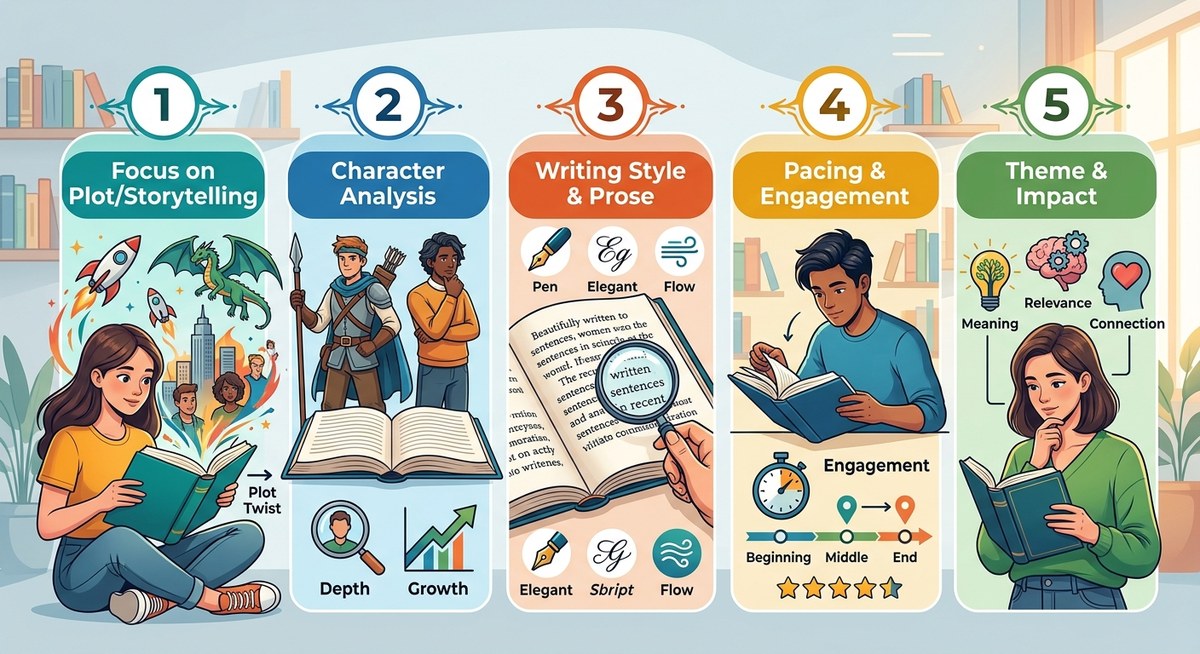
5 Book Review Tricks That Reveal Whether a Novel Is Worth Reading
Let’s be honest. You have probably picked up a hyped novel, read fifty pages, and wondered why anyone liked it. Or you have scrolled through Amazon reviews for half an hour and still felt unsure. That is normal. The problem is not you. It is that most readers do not have a system. They rely on chance. This guide will give you a repeatable method. After today, you will know how to tell if a book is worth reading in under five minutes.
Skip the hype. Judge a book by three signals: does the opening paragraph grab you, do reviewers mention flaws honestly, and does the author’s voice match your taste. Use our 3-question filter, then scan reviews for spoiler-free plot clues. Apply the 5-step checklist before you buy. You will save hours and love more of what you read.
Why Most Readers Waste Time on the Wrong Books
Every year, thousands of new novels land on shelves. The average person reads maybe a dozen books annually. With that ratio, you cannot afford to waste chapters on duds. Yet most readers do not have a clear process. They trust a friend’s recommendation blindly. They grab whatever has a pretty cover. They assume a 4.5-star rating means it is safe.
The truth is different. A high star rating can come from a few fanatical fans. A beautiful cover can hide a weak plot. And even a trusted friend might love a genre you hate. To avoid this, you need a lightweight filter. One that works for any book, any genre, any age group. The method below is built from talking to librarians, editors, and hundreds of happy readers. It takes three minutes to apply.
The 3 Questions That Reveal a Book’s Value Instantly
Before you read a single review, ask yourself these three questions. Write the answers down. They will tell you 80% of what you need.
1. Does the opening paragraph make you curious?
If you can read the first two sentences and not feel a tug, put the book down. Great fiction starts with a hook. It could be a strange detail, a conflict, or a voice that sounds different. The opening should promise something. If it promises nothing, the rest will likely keep nothing.
2. Do the reviewers disagree in a useful way?
Perfect scores are suspicious. Real books have real flaws. Look for reviews that say things like “the pacing dragged in the middle but the ending was worth it.” That shows honest judgment. Avoid books where every review reads the same. That is a sign of coordinated hype, not genuine opinion.
3. Does the author’s style match what you enjoy?
You know your preferences. Do you like short chapters? Long descriptive passages? Fast dialogue? Read a sample page. If the rhythm feels off, it will for the whole book. Trust your ear.
If you answer “no” to any of these, the book is probably not worth your time. If you answer “yes” to all three, move on to scanning the reviews.
How to Scan a Review Like a Pro
Not all reviews are equal. Some are written by people who skimmed the book or wanted a free copy. Others are written by careful readers who think about plot, character, and pacing. You need to tell them apart. The table below shows the difference.
| Good Review | Fluff Review |
|---|---|
| Mentions specific scenes or quotes | Uses vague phrases like “loved it” or “great characters” |
| Discusses a weakness (pacing, dialogue, ending) | Only praises, no criticism |
| Gives context: “if you like X author, you will like this” | No comparison or reference |
| Says why the book mattered to them emotionally | Only says “page-turner” or “unputdownable” |
| Is written in their own voice, not a press release | Sounds like a marketing blurb |
Use this table as a quick checklist. If the first three reviews you read are all fluff, move to another source. For a deeper look at what separates useful reviews from waste, read our article on 5 Signs a Book Review Is Worth Your Time (And 3 That Aren’t).
5 Practical Steps to Decide If a Book Is Worth Reading
Here is a repeatable process. Do these steps in order. By the end, you will have a clear yes or no.
-
Read the first page aloud. Your voice will catch awkward sentences. If you stumble over the prose, the author did not polish it. Close the book.
-
Find three reviews that mention a flaw. Use a site that allows sorting by “most helpful” or “critical.” See how bad the flaw is. If everyone says the ending is terrible, believe them. If only one person says it, ignore that.
-
Check the author’s backlist. If this is their first novel, read a sample before committing. If they have several books, see if later ones got better reviews. Some authors peak early; others improve.
-
Look up a summary of the plot (with spoilers). This might sound odd, but it works. Spoilers reveal whether the story has a satisfying structure. If the plot summary sounds boring, skip it. Knowing the ending does not ruin a good book; it lets you see if the journey is worth taking.
-
Set a 50-page limit. Buy or borrow the book. Read to page 50. If you are not invested, stop. No guilt. Life is too short for books that do not pull you in.
These steps work for any type of fiction, from kids’ books to adult literature. For more tailored advice based on the reader’s age, see our guide on How to Choose the Perfect Book for Every Age and Interest.
Red Flags That Scream “Skip This Book”
Sometimes you can spot a dud without reading a word. Watch for these warning signs.
- The book was released five years ago and has fewer than 100 reviews on a major platform. If nobody has talked about it for that long, there is usually a reason.
- The author has multiple one-star reviews that mention the same problem (bad grammar, flat characters, plot holes).
- The sample page uses more than three clichés in the first paragraph.
- The review copy is described as “advanced reader copy (ARC)” and every review is five stars. ARCs often attract fans who feel obligated to be positive.
- The book is part of a series, but reviewers say you must read the previous books. That is fine, but it means you need to commit to a whole series to get a complete story. Decide if you want that.
For a deeper understanding of what makes a review trustworthy, check out Why Book Reviews Are the Secret to Finding Books You’ll Actually Love.
The One Trick That Changed How I Read
I learned this from a bookstore owner in Portland. She said:
“Stop reading reviews that tell you what the book is about. Read reviews that tell you how the book made them feel. The difference is everything. Plot summaries are on the back cover. The feeling is why you buy it.”
She was right. A review that says “this book made me cry on a bus” tells you more than one that says “a story about a girl who moves to a new town.” The emotional reaction is a signal. If a review makes you feel curious about that emotion, you will probably enjoy the book. If the emotion sounds boring or uncomfortable, trust that.
This trick works for parents picking books for children, too. A child’s emotional reaction to a story is the best predictor of whether they will finish it. When you browse reviews for your kids, focus on what the child felt, not what the parent thought.
Match the Method to the Reader
Different readers need slightly different filters. Here is a quick guide.
-
For children (ages 0 to 8): Look at reviews from other parents and teachers. Focus on illustrations, readability, and whether the story encourages interaction. Check out our Discover the Best Children’s Book Reviews to Help Your Little Reader Find Their Next Favorite.
-
For teens (ages 13 to 18): Free reviews on Goodreads or a teen-specific site. Young readers often care about relatable characters and current topics. See The Best Teen Book Reviews to Inspire Young Readers and Boost Their Love for Literature.
-
For adult fiction lovers: Use the 3-question filter and the 5-step checklist above. Supplement with award lists but remember that awards are not everything. Top Award-Winning Adult Fiction to Add to Your Reading List can give you a starting point.
-
For parents buying for kids of all ages: The same principles apply but pay extra attention to age-appropriateness. Use our Top Book Reviews Every Parent Should Read Before Choosing Their Child’s Next Read.
Stop Guessing, Start Reading with Confidence
You now have a system. It is simple. Ask the three questions. Scan reviews with the good-versus-fluff table. Run the five-step checklist. Watch for red flags. Pay attention to emotional reactions in reviews. That is all it takes.
Next time you stand in a bookstore or scroll through a list, take two minutes to apply this method. You will leave with a book that fits. You will finish more stories, abandon fewer, and enjoy the process more. That is the whole point of reading.
Go ahead. Pick a novel that has been sitting on your wish list for months. Use the filters. If it passes, buy it. If it does not, move on without guilt. Your reading time is precious. Treat it that way.