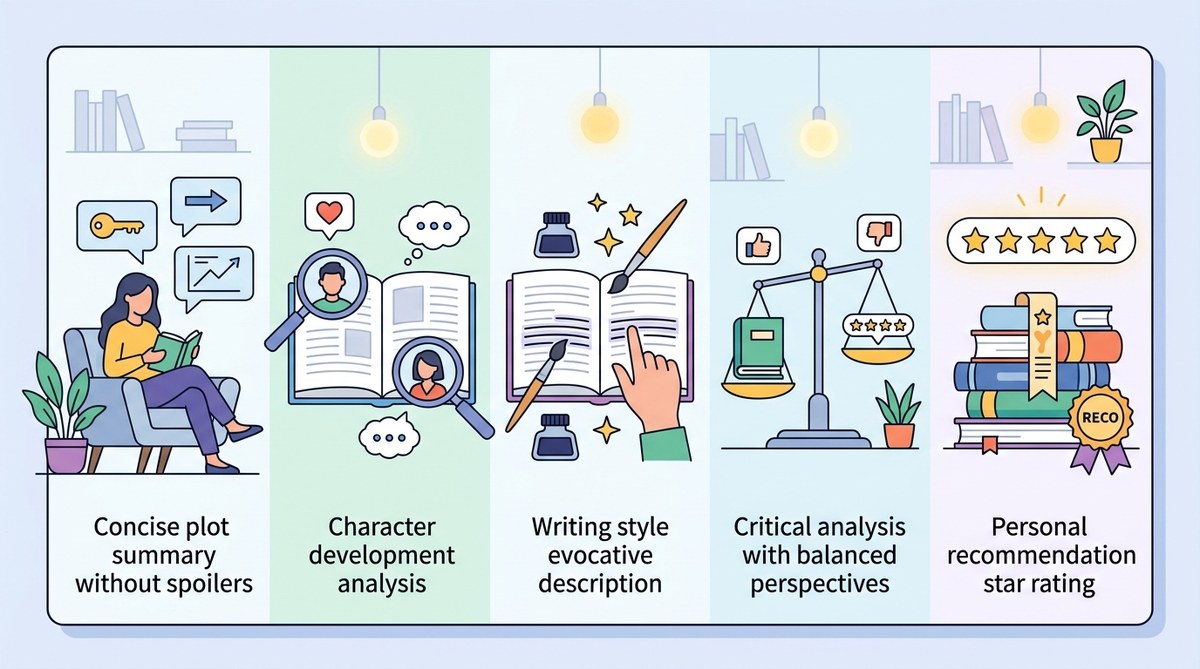
5 Elements Every Great Book Review Must Have
Writing a book review can feel like a tightrope walk. You want to share your honest opinion without giving away the whole plot. You want to help someone decide if a book is right for them, but you also do not want to spoil the magic. The difference between a review people skim and a review they actually act on comes down to a handful of core ingredients. Whether you are writing for a class assignment, a personal blog, or a platform like Goodreads, understanding the elements of a good book review will make your writing sharper and more helpful. Let us break down exactly what those pieces are and how you can put them together with confidence.
A strong book review balances five key parts: a spoiler-free summary, character analysis, writing style assessment, honest plot critique, and a clear recommendation. Each element serves a specific purpose for the reader. When you include all five, your review becomes a trusted guide that helps others choose their next read and improves your own critical thinking skills as a writer.
Why the Right Structure Makes Your Review Stand Out
Readers come to a review looking for answers. Will I like this book? Is it worth my time? Is it appropriate for my child or student? If your review rambles or skips around, they will bounce. A clear structure signals that you know what you are talking about. It builds trust fast.
Think of the five elements as the骨架 of your review. Once you have them down, you can rearrange them to fit your voice. But leaving one out often leaves your reader with unanswered questions.
Here is a breakdown of each element and why it matters.
1. A Useful Summary That Respects the Reader
The first element is a concise summary of the book. This is not a book report. You do not need to recount every chapter. Instead, give enough context so someone can understand what the book is about at a high level.
What to include in your summary:
- The genre and target audience
- The main character and their central goal
- The setting or time period
- The central conflict or question
What to avoid:
- Major plot twists or the ending
- Detailed subplot explanations
- Your personal opinion (save that for later)
“A great summary acts like a movie trailer. It shows the premise and the stakes without revealing the final scene. Your reader should finish your summary thinking, ‘I want to know what happens next’ not ‘Well, now I already know what happens.'” This rule of thumb comes straight from experienced book bloggers who have learned that spoiler-free summaries drive more clicks and trust.
For example, if you are reviewing a middle grade novel, you might write: “This story follows a twelve year old who moves to a new town and discovers a hidden library that only appears at dusk. She must solve a series of puzzles before the library vanishes for good.” That is enough. Do not explain which puzzle solves which mystery.
2. Character Analysis That Goes Beyond Like or Dislike
Characters are the heart of any story. A review that only says “I loved the main character” does not help anyone. The second element asks you to go deeper.
Questions to guide your character analysis:
- Did the character feel believable, or did they act how the plot needed them to?
- Did the character grow or change by the end?
- Were the side characters fully drawn, or did they feel like props?
- Did the dialogue sound natural for the age group?
For student reviewers, this is often where teachers want to see critical thinking. For bloggers, this is where you connect emotionally with your audience. When you describe how a character reminded you of yourself or someone you know, the review becomes personal and memorable.
You can use a simple table to organize your character thoughts when drafting:
| Aspect | What to Look For | Example Question |
|---|---|---|
| Motivation | Clear goals that drive actions | Does the character want something specific? |
| Growth | Change from start to end | Do they learn a lesson or stay the same? |
| Voice | Distinct way of speaking | Would you recognize their dialogue without a tag? |
| Believability | Consistency with age and background | Would a real ten year old act this way? |
3. Writing Style and Tone Assessment
The third element focuses on how the book is written, not just what happens. This is where you show your knowledge as a writer or a careful reader. You do not need to use fancy literary terms. Plain language works fine.
Things to notice about writing style:
- Sentence length and rhythm. Are the sentences short and punchy or long and descriptive?
- Word choice. Is the vocabulary simple or rich? Does it fit the intended age group?
- Pacing. Does the story drag in the middle or race to the end?
- Point of view. Does first person or third person serve the story well?
For example, if you are reviewing a YA thriller, you might note that the chapters are short and each one ends with a small cliffhanger. That is a style observation that tells readers the book is built for speed. If you are reviewing a literary novel for adults, you might comment on the lyrical prose and how it slows the reading experience in a good way.
This element is especially important for teachers and parents who want to match a book to a child reading level or attention span.
4. Honest Critique of Plot and Pacing
The fourth element is where you get to voice what worked and what did not. A good review is not a list of complaints. It is a balanced assessment. You are allowed to love a book and still mention a flaw. You are also allowed to dislike a book and still point out something it did well.
What to evaluate in the plot:
- Was the premise original or familiar?
- Were there plot holes or convenient coincidences?
- Did the stakes feel real and urgent?
- Was the ending satisfying or rushed?
For pacing, ask yourself: did I ever feel bored? Did I ever feel confused? Those are honest data points that help other readers.
This is also a good place to compare the book to others in the same genre. For instance, “Fans of The Hunger Games will recognize the tournament structure here, but this book adds a twist with memory loss that changes the stakes.” Comparisons give readers a frame of reference.
5. A Clear Recommendation with Context
The final element is the most actionable. After reading your review, someone should know exactly who this book is for. You should also state whether you recommend it and why.
A strong recommendation answers these questions:
- What age group is this best suited for?
- What type of reader would enjoy this? (fans of action, fans of romance, reluctant readers, etc.)
- Would you read more by this author?
- Would this work as a classroom read aloud, a bedtime story, or a solo read?
You can format your recommendation as a simple statement: “I recommend this book for readers ages 10 to 14 who enjoy fantasy with strong friendships. If you liked The School for Good and Evil, you will probably enjoy this one too.”
Common Mistakes to Avoid in a Book Review
Even experienced writers fall into traps. Here are the most frequent mistakes and how to avoid them.
- Spoiling the ending without warning. Always put a spoiler warning if you must discuss the finale. Better yet, keep the ending out of the review entirely.
- Writing only a summary. A recap is not a review. Your opinion and analysis must come through.
- Being vague. Instead of “the writing was good,” say “the dialogue felt natural and the descriptions made the setting come alive.”
- Forgetting the audience. A review for a picture book sounds different from a review for an adult thriller. Match your language to the readers you want to reach.
- Overusing star ratings without explanation. A star rating is helpful, but only if you explain what it means in your own words.
How to Draft a Book Review in Five Steps
If you are feeling stuck, follow this simple process. It works for a 300 word blog post or a 1000 word analysis.
- Read with a notebook nearby. Jot down your reactions as you go. Highlight quotes that stand out. This makes writing later much easier.
- Write the summary first. Get the basic facts down. This warms you up and gives your review a foundation.
- Pick one or two elements to focus on. You do not need to cover everything. Choose what stood out most about the book.
- Add your personal reaction. How did the book make you feel? Did it remind you of anything in your own life? Personal touches make reviews memorable.
- End with a recommendation. Be direct. Tell the reader whether to buy it, borrow it, or skip it.
You can adapt these steps to any age group or genre. For help choosing books that might interest your audience, check out our guide on how to choose the perfect book for every age and interest.
Putting the Elements into Practice
Here is a look at how the five elements come together in a real review snippet. Imagine you are reviewing a children’s picture book.
Element 1 (Summary): “This picture book follows a young rabbit who is afraid of the dark. His grandmother shows him how the moonlight makes everything look different and beautiful.”
Element 2 (Characters): “The rabbit feels real for a preschooler. His fear is specific, not generic. The grandmother is patient and warm, which makes the story comforting.”
Element 3 (Writing Style): “The text uses short sentences and repeating phrases that young children will chime in on. The rhythm is gentle, perfect for bedtime reading.”
Element 4 (Plot): “The story is simple, which is right for the age group. There is no real conflict beyond the fear, but that is enough for a three year old.”
Element 5 (Recommendation): “I recommend this for children ages 3 to 5 who are going through a fearful stage. It would work well as a bedtime story or a preschool circle time read.”
See how each element adds a layer? Together they form a complete picture.
How to Adapt Your Review for Different Age Groups
The same five elements apply whether you are reviewing a board book or a literary novel for adults. But the emphasis shifts.
For children’s books, focus on engagement, illustrations, and age appropriateness. Parents want to know if a book will hold attention and if the themes are suitable.
For teen books, emphasize character relatability, pacing, and emotional impact. Teen readers want to know if the story speaks to their lives.
For adult fiction, focus on writing style, originality, and thematic depth. Adult readers often look for something that challenges or entertains them in equal measure.
If you write reviews across age groups, you will find that the core questions stay the same: who is this for, what happens, and is it worth reading? The ultimate guide to book reviews that actually match your tastes can help you refine your voice for different audiences.
Why Your Reviewing Skills Matter More Than You Think
Writing book reviews is not just about helping others find good books. It also sharpens your own reading and writing skills. When you practice identifying the five elements, you become a more critical reader. You notice things you might have missed before. You start to see how authors build plots and characters.
For students, this skill directly translates to better essays and analytical writing. For bloggers, it builds a loyal audience who trusts your recommendations. For aspiring writers, it teaches you craft by example.
The best part is that you do not need to be an expert to start. You just need a book, a notebook, and a willingness to share your honest thoughts.
A Final Checklist for Your Next Review
Before you hit publish, run through this list:
- Did I include a spoiler free summary?
- Did I say something specific about the characters?
- Did I comment on the writing style or pacing?
- Did I share both what worked and what did not?
- Did I tell the reader exactly who this book is for?
If you can answer yes to all five, your review is ready to help someone find their next great read. And if you want to see how other reviewers handle these elements, browse our collection of must-read book reviews for adult fiction enthusiasts or check out the best teen book reviews to inspire young readers.
Building a Habit That Lasts
The easiest way to get good at writing reviews is to do it regularly. Start small. Write one review a week. Focus on one element at a time until each feels natural. Before you know it, you will have a portfolio of reviews that other readers rely on.
Remember that your voice matters. No one else has your exact perspective. The five elements give you a structure, but your personality makes the review sing. Be honest. Be specific. And keep reading.
Your next review could be the one that helps a reluctant reader find the book that changes everything for them. That is a pretty powerful thing to be part of.