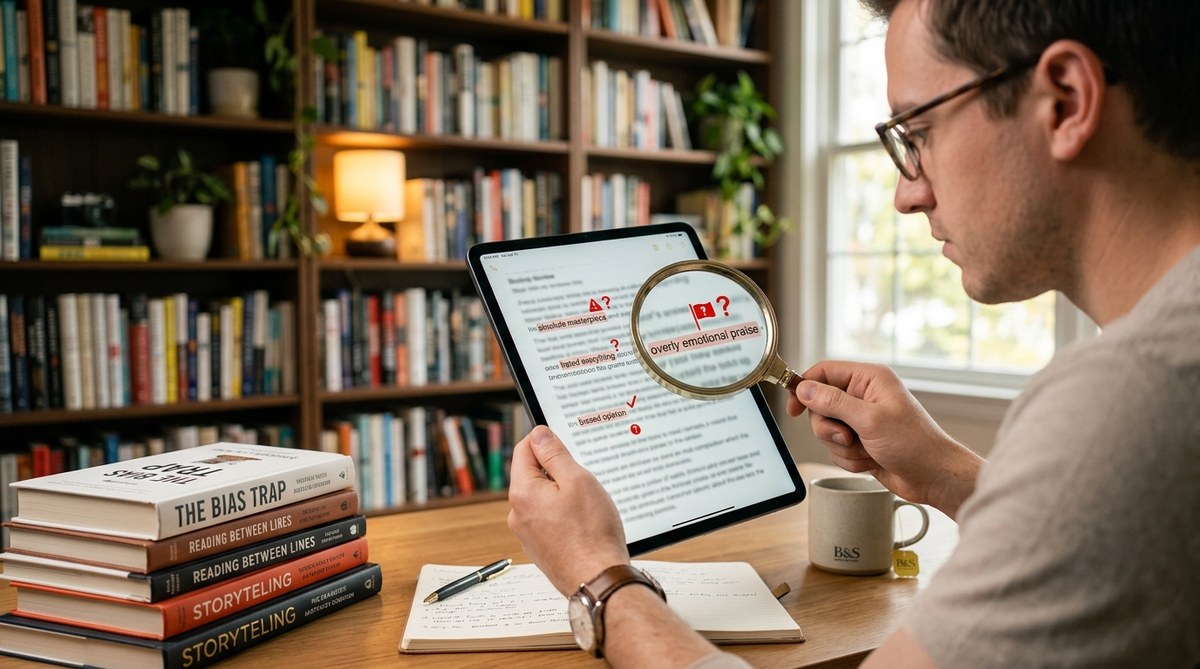
How to Spot a Biased Book Review Before You Waste Your Time
You pick up a book everyone’s talking about. You read a few reviews. The first one is glowing: “Best thing I’ve read all year!” The next one is brutal: “Utter waste of paper.” Two people, two completely different takes. Which one do you trust? If you’ve ever spent money on a book that turned out to be nothing like the reviews described, you know the frustration. A biased book review can trick you into buying something you’ll hate — or make you miss out on a story you’d love. In 2026, with hundreds of millions of reviews online, learning to spot bias is a superpower.
A biased book review isn’t always obvious. It hides behind emotional language, personal attacks on the author, or one-sided praise that ignores flaws. To save time, look for extreme ratings, vague complaints, and reviews that focus on the reviewer’s own taste instead of the book’s content. Cross-check multiple sources, and trust reviews that point out both strengths and weaknesses. Your next great read depends on reading between the lines.
## What Makes a Book Review Biased?
Bias creeps in when a reviewer lets personal feelings, outside pressures, or hidden agendas shape their opinion. Not all bias is intentional. A reader who loves a specific genre might unconsciously overlook flaws in a book that fits their favorite tropes. Meanwhile, a reviewer who had a bad experience with an author on social media might write a review that’s more about settling scores than evaluating the story.
A truly helpful review gives you a balanced look at what the book does well and where it falls short. A biased review tilts the scale so far in one direction that it stops being useful.
## Why It Pays to Spot Bias Early
Every hour you spend reading a book you don’t enjoy is an hour you can’t get back. And every dollar wasted on a disappointing purchase adds up. Learning to identify a biased book review is the best way to protect your reading time and your budget.
Beyond saving money, spotting bias helps you build a personal reading filter. Over time, you’ll learn which reviewers share your taste and which ones you should ignore. That skill makes choosing your next book faster and more satisfying.
## 5 Red Flags in a Biased Book Review
Here are the most common signs that a review is being driven by something other than the book’s quality.
1. **Extreme language with no specifics.** If a review is full of words like “brilliant,” “perfect,” or “horrible” but never mentions a single character, plot point, or writing technique, be suspicious. Real readers talk about what worked or didn’t work. They don’t just scream “five stars!”
2. **Personal attacks on the author.** A reviewer who spends more time insulting the author’s personality, politics, or past behavior than discussing the book is not giving you useful information. Ignore those reviews.
3. **One-star ratings with no evidence of having read the book.** Look for reviews that say things like “I couldn’t get past page ten” or “I hated the cover so I stopped.” These tell you nothing about the story. They’re noise.
4. **Five-star reviews that sound like advertising.** When a review reads like a press release, full of generic praise like “a must-read” and “life-changing,” it might be a paid or incentivized review. Real readers mention specific scenes or emotions.
5. **Reviews that are clearly about the reviewer’s own taste, not the book.** Phrases like “I don’t like this genre” or “I prefer faster pacing” are honest, but they don’t help you decide. A good review owns its bias but still evaluates the book on its own terms.
## A Checklist to Scan a Review Quickly
Before you trust a review, run through this list. If you check off three or more items, the review is likely biased.
– The review uses all caps or excessive exclamation points.
– It contains zero specific plot or character details.
– The reviewer admits they haven’t finished the book.
– It mentions the author’s personal life or political views more than the story.
– The rating is at the extreme ends (1 or 5) with no middle ground.
– The review is incredibly short (one sentence) or extremely long and rambling.
– It uses phrases like “everyone should read this” or “no one should waste their time.”
– Multiple reviews by the same person for different books all sound identical.
## Objective Review vs. Biased Review: A Side-by-Side Comparison
| **Aspect** | **Objective Review** | **Biased Review** |
|————|———————-|——————-|
| Language | Balanced, specific, uses moderate words | Emotional, hyperbolic, uses extremes |
| Focus | Characters, plot, writing style, pacing | The reviewer’s feelings, the author’s identity, or outside factors |
| Specific examples | Gives a concrete scene or quote | Offers only vague generalities |
| Rating range | Often 2-4 stars, acknowledges pros and cons | Almost always 1 or 5 stars |
| Tone | Respectful, even when critical | Sarcastic, angry, or gushing |
| Purpose | To inform a potential reader | To vent, promote, or attack |
## How to Verify a Review
Don’t stop at one review. Use these steps to get a clearer picture.
First, read a cluster of reviews from different angles. Look at the 3-star reviews. They are often the most honest because the reviewer had mixed feelings and felt compelled to explain them. Three-star reviews tend to list specific pros and cons.
Second, check the reviewer’s history. Does this person consistently give high or low ratings to all books? If someone has a string of 5-star reviews, they might be a generous reader — or they might be inflating ratings. Similarly, a reviewer who never gives above 2 stars is probably too critical to be useful.
Third, see if the review mentions comparable books. A reviewer who says “If you liked *Project Hail Mary*, you’ll enjoy this” shows they understand the genre and can give you a meaningful comparison.
Finally, cross-reference with professional reviews from sources like Kirkus, Booklist, or respected book bloggers. These outlets have editorial standards and are less likely to publish a biased book review.
> “The most reliable reviews are the ones that make you feel like you’ve just talked to a friend who read the book last week. They’ll tell you what they loved, what they skimmed, and why — without trying to sell you or scare you away.” — Rachel K., independent book reviewer and librarian
## Using What You’ve Learned to Choose Better Books
Once you can spot a biased book review, you’ll start noticing patterns everywhere. That five-star rave with zero substance? Skip it. That one-star rant that only attacks the author? Ignore it. The three-star review that explains exactly why the middle of the book dragged? That’s gold.
Combine this skill with our guide on [5 Signs a Book Review Is Worth Your Time](https://booksandstuff.info/5-signs-a-book-review-is-worth-your-time-and-3-that-aren-t/) to narrow down your choices even faster. And if you want to become a better reviewer yourself, check out [How to Write a Book Review That Helps Other Readers](https://booksandstuff.info/how-to-write-a-book-review-that-helps-other-readers-and-yourself/).
Remember, not every extreme review is malicious. Some people genuinely love or hate a book with passion. But when a review lacks specific details and seems driven by something other than the text, it’s time to move on. Trust the reviews that treat you like a smart reader. The ones that say, “Here’s what worked for me, here’s what didn’t, and here’s why you might feel differently.”
## Turn This Into a Habit
The next time you’re browsing for a new read, take 30 seconds to scan the top three reviews. Use the checklist. Look at the rating distribution. Ignore the outliers. Focus on the middle. Over time, you’ll build a mental library of trusted voices — and you’ll rarely pick a dud again.
For more help finding books you’ll love, explore our collection of [Top Book Reviews Every Parent Should Read](https://booksandstuff.info/top-book-reviews-every-parent-should-read-before-choosing-their-childs-next-read/) or the [Ultimate Guide to Book Reviews That Actually Match Your Tastes](https://booksandstuff.info/the-ultimate-guide-to-book-reviews-that-actually-match-your-tastes/). Happy reading.