Why You Should Read Negative Book Reviews First (and How They Save You Money)
You are scrolling past a five star review that says “This book changed my life.” Then you see another, and another. The hype machine is running at full speed. You add it to your cart. Three days later you are staring at pages that feel flat, characters that never click, and a plot that wanders. You just spent $16 on a book that will sit on your nightstand until it goes to the donation pile. What if there was a way to avoid that scenario almost every time? There is. The answer is simple but counterintuitive: read the negative reviews first.
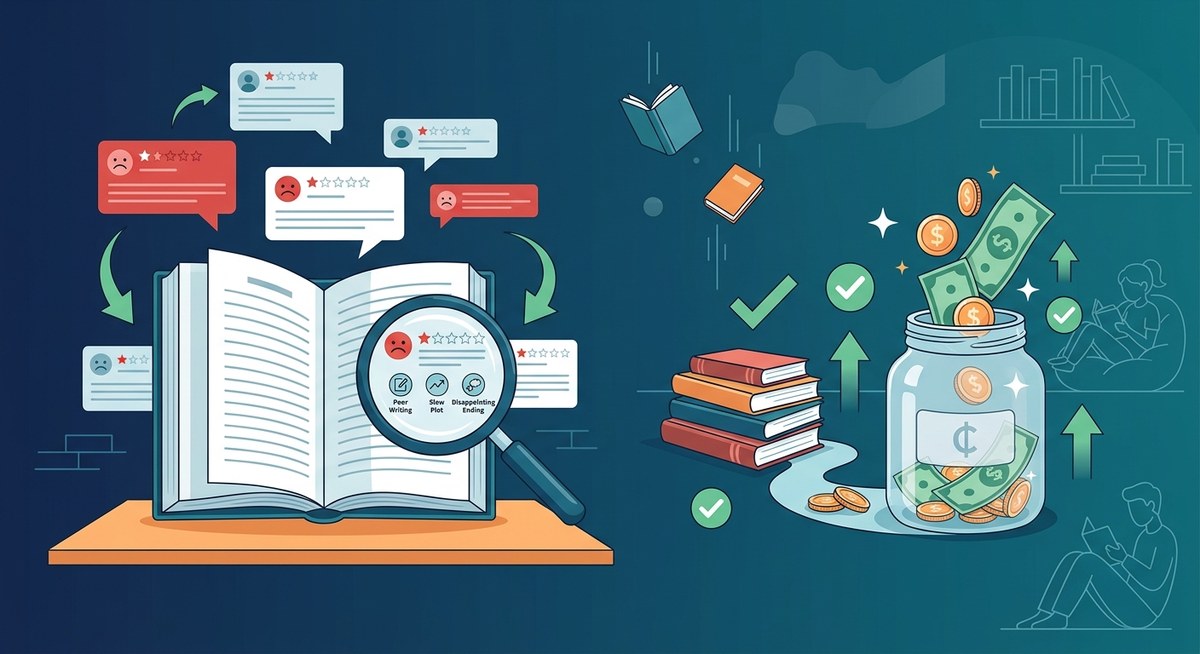
Negative book reviews are not haters; they are your best filtering tool. By reading critical reviews before the glowing ones, you learn exactly what could go wrong for a reader like you. You spot pacing issues, weak dialogue, or mismatched genres. This practice saves you money, time, and disappointment. The trick is to separate constructive criticism from nitpicking.
Stop Wasting Money on Books That Don’t Deliver
A new hardcover runs between $20 and $30. Even a paperback can be $12 to $18. If you buy five books a year that you end up disliking, you are throwing away $60 or more. That is the cost of a nice dinner or a streaming subscription for two months. As a budget conscious buyer, you want every dollar to count. The problem is that most readers rely on the average star rating or the first few reviews they see. Those are almost always positive.
Why? Because people who loved a book rush to review it. People who hated it might leave a quick rant. The middle ground, the nuanced critique, takes effort. That is where the real value hides. When you read negative reviews first, you are looking for patterns. If multiple reviewers mention the same flaw, you can bet it is real. That flaw might be a dealbreaker for you, or it might be something you can overlook. Either way, you go into the purchase with eyes open.
How to Find Genuine Negative Reviews
Not all negative reviews are created equal. Some are rants from readers who clearly did not read the genre description. Others are personal dislikes that have nothing to do with quality. Your job is to filter.
Here are the best places to find honest critical reviews:
- Goodreads and Amazon filtered by lowest rating. Skip the 1 star and look at 2 and 3 star reviews first. Those often have balanced criticism.
- Book blogs that specialize in your favorite genre. Many genre focused blogs are not afraid to call out weak entries.
- Subreddits like r/books or r/Fantasy. Search for “disappointed by” or “unpopular opinion” threads.
- LibraryThing or StoryGraph. These platforms attract deeper analysis and less hype.
Our guide on how to spot a biased book review before you waste your time can help you separate genuine feedback from noise.
The Science Behind the Scam of High Star Averages
Studies have shown that a book with a 4.5 star average is more likely to have a few hundred reviews skewed by early fans. Books with a 3.8 to 4.2 star average often have a more honest distribution. There is a concept called the J shaped distribution, where most ratings are 5 stars, a few are 1 star, and very few are in between. That pattern often signals a book that is either amazing for a specific reader or terrible for everyone else.
When you see a book with thousands of 5 star reviews and only a handful of critical ones, ask why. Sometimes it is a genuine hit. Other times the author or publisher aggressively marketed to their fanbase before the general public got a chance to weigh in. By reading negative reviews first, you catch the dissenting voices that reveal the book’s true strengths and weaknesses.
A Table to Help You Distinguish Helpful from Unhelpful Criticism
| Type of Negative Review | Looks Like This | Useful or Not? | Why |
|---|---|---|---|
| Specific complaint about pacing | “The first 150 pages drag. Nothing happens until chapter 12.” | Useful | You can judge your own patience for slow starts. |
| Subjective genre mismatch | “I hate first person present tense.” | Not useful | That is a personal preference, not a quality issue. |
| Fair warning about writing style | “The dialogue is stilted and every character sounds the same.” | Useful | If you care about realistic dialogue, this matters. |
| Vague rant | “This book is terrible. Don’t waste your money.” | Not useful | No explanation means nothing you can assess. |
| Technical criticism about plot holes | “The main character acts illogically in chapter 5 for no reason.” | Useful | Plot holes are objective flaws. |
| One star because of shipping damage | “Arrived with a torn cover.” | Not useful | That is a shipping issue, not a book issue. |
Use this table as a cheat sheet while scanning reviews. Ignore the noise. Focus on the signal.
A Step by Step Process to Save Money with Negative Reviews
Here is a simple system you can use before adding any book to your cart.
- Open the book’s page on your preferred review platform.
- Sort reviews by rating, starting with 2 stars. Read the first five to eight reviews at that level.
- Take notes on recurring complaints. If three reviewers mention slow pacing, that is a real pattern.
- Check the 1 star reviews for the same issues. If the complaints match, you have found a consistent flaw.
- Now read a few positive reviews, but only after you know the weaknesses. You will see whether the positives outweigh the negatives for your taste.
- Decide whether the flaw is acceptable to you. For example, if the book is slow but has beautiful prose, and you love literary fiction, it might still be a good buy.
- If the flaw is a dealbreaker, move on to another title. You just saved $15 to $25.
That is the whole method. It takes about ten minutes. Compare that to the hours you might spend forcing yourself through a book you hate.
Common Mistakes When Using Negative Reviews
Even smart readers fall into these traps. Avoid them.
- Ignoring the ratio of negative to positive. If only 5% of reviews are negative, the book might be great for most people. Do not let a few critical voices scare you off.
- Dismissing all negative reviews as “haters.” Some are, but many are trying to help.
- Only reading the most popular negative review. The top critical review might be an outlier. Read several.
- Confusing personal taste with objective quality. A reviewer who hates a genre is not helpful.
- Forgetting to check the reviewer’s other reviews. If someone always gives 1 star, their opinion is less valuable.
For a deeper understanding of what makes a review trustworthy, check our article on 5 signs a book review is worth your time (and 3 that aren’t).
What the Experts Say
“A negative review is a gift. It tells you exactly what kind of reader will not enjoy this book. If you are that reader, you saved yourself time and money. If you are not that reader, you just learned something about the book’s limits. I always read the three star reviews before I buy. Those are written by people who wanted to like it but could not. They are the most honest.” — Rachel Samuels, book blogger at The Critical Shelf
That advice matches my own experience. The 3 star reviewers are the sweet spot. They are not angry. They are not fawning. They simply describe what worked and what did not.
How This Connects to Choosing Books for Kids and Teens
If you are a parent or teacher, the stakes are even higher. Children and teens have less tolerance for boring or poorly written books. They will abandon a book after ten pages if the story does not grab them. A negative review for a children’s book that says “too slow for an 8 year old” or “the vocabulary is too advanced” is incredibly valuable. It helps you match the book to the reader’s skill level and interest.
Our guide on how to choose age appropriate kids books for every reading stage uses a similar principle: pay attention to what real parents and educators say, not just the star count.
For teens, the same logic applies. A negative review about “cringey dialogue that feels like an adult trying to sound like a teen” is a huge red flag for a YA novel. Check out our list of must read teen books that inspire confidence and growth for titles that real teens have vetted through their honest feedback.
When Negative Reviews Fail You
No method is perfect. Here are three situations where reading negative reviews first might not help.
- New releases with very few reviews. You might only have a handful of reactions. Patterns are harder to spot.
- Books by debut authors with a small fanbase. Early reviews can be skewed by friends and family.
- Very popular books where negative reviews are drowned out. A bestseller with 100,000 reviews still has useful criticism, but it takes more filtering.
In those cases, try to find reviews from professional critics or trusted booktubers who are not afraid to be honest. Also consider borrowing the book from a library first. That is the ultimate test drive.
Turn the Critical Lens on Your Own Reading Habits
The best part of this strategy is that it trains you to become a more aware reader. You start paying attention to what matters to you. Do you care more about plot or prose? Do you tolerate slow world building if the payoff is good? After a few months of reading negative reviews first, you will know your preferences better than ever. That knowledge saves you money because you stop taking risks on books that are not designed for you.
Look at it this way. Every book you purchase is a gamble. Negative reviews are the odds. By reading them first, you tilt the odds in your favor. You stop buying based on hype and start buying based on evidence. Your wallet will thank you, and your bookshelf will be filled with books you actually want to read.
Make This Your New Book Buying Habit
Start small. The next time you see a book that catches your eye, resist the urge to hit “buy”. Open the reviews. Scroll to the 2 star section. Read three of them. Then decide. Repeat that for a week. You will notice a shift in how you think about book marketing. You will see through the hype.
If you want to refine your approach further, read our ultimate guide to book reviews that actually match your tastes. It covers everything from review sites to personal bias.
And remember, a negative review is not a personal attack on the author. It is data. Use it. You are the boss of your own reading experience. Make informed choices, spend wisely, and enjoy every page you turn.