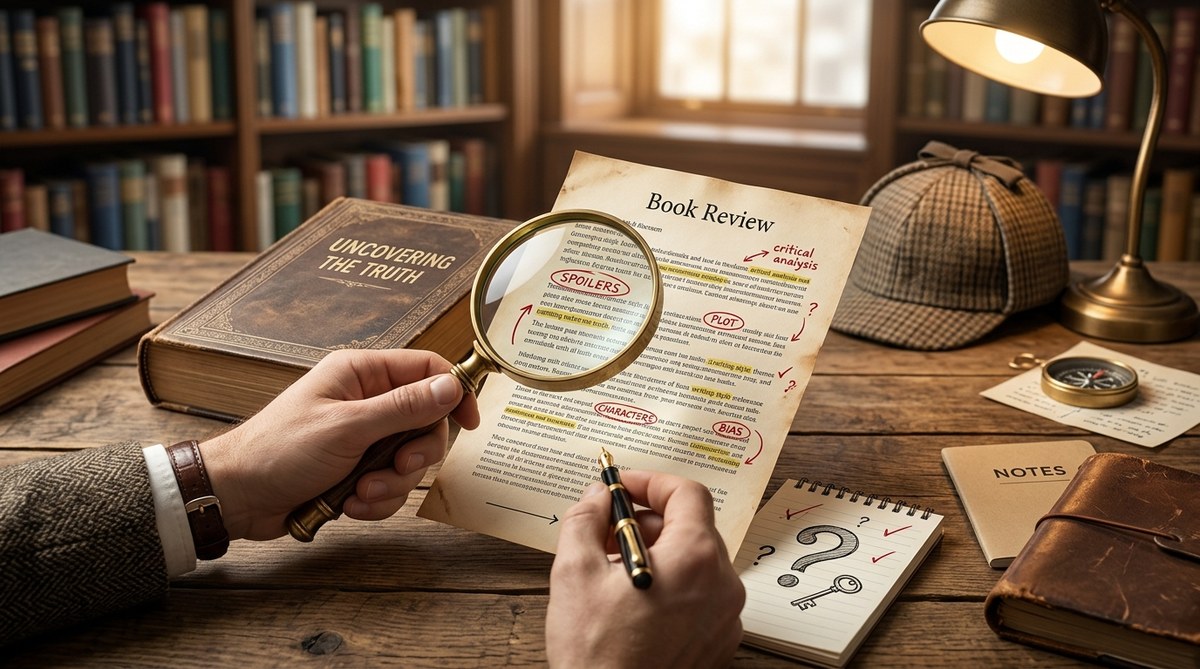
How to Read a Book Review Like a Detective and Uncover the Truth About Any Novel
You have fifteen minutes to pick a book for your weekend. You open a review, scan a few lines, and see the words “masterpiece” and “beautifully written.” But you have been burned before. That five-star review led you to a slow, poetic novel that you abandoned on page thirty. Something felt off. The review was glowing, but it did not describe what you actually care about.
Most readers make the same mistake. They read a review for confirmation, not for information. They look at the star rating and the final verdict, and they ignore the clues hidden in the text. A book review is not a simple thumbs up or thumbs down. It is a piece of evidence. And like any good detective, you need to learn how to read a book review with a critical eye.
To read a book review like a detective, you must ignore the star rating and focus on what the reviewer actually says about pacing, character depth, and plot structure. Look for specific details that match your personal taste. A negative review can reveal more than a positive one. Always check the reviewer’s bias and read between the lines.
Why Most Readers Get Fooled by Book Reviews
The biggest trap in reading a book review is trusting the score. A four-star review from a critic who loves literary fiction will feel completely different from a four-star review from a fan of fast-paced thrillers. The star rating is a summary of one person’s experience. It is not a universal truth.
Consider this. A reviewer gives a novel three stars and writes that the plot was slow but the character development was incredible. If you are someone who loves deep, psychological character studies, that review is actually a glowing recommendation for you. But if you skimmed the review and only saw the three stars, you might have passed on a book you would have loved.
The same logic applies to five-star reviews. A reviewer who gives five stars to every book they read is not helping you. They are not discriminating. Their praise becomes noise.
“A review is only as useful as the reviewer’s ability to articulate what they liked and disliked. If they can’t tell you why, they can’t tell you anything.”
The 3-Step Method to Read a Book Review Like a Detective
To get the truth out of any review, follow this simple process. It takes less than two minutes and will save you from buying books that do not match your taste.
Step 1: Identify the Reviewer’s Bias
Every reviewer brings baggage to the page. Some of it is obvious. Some of it is hidden. Ask yourself these questions:
- Did the reviewer receive a free copy from the publisher? If so, they might be inclined to be generous.
- Is this reviewer a friend of the author? Check their other reviews. Do they only review books from a small circle of writers?
- Does the reviewer specialize in a specific genre? A romance reviewer will have different standards than a horror reviewer.
- Does the reviewer mention their own reading habits? If they say “I usually hate fantasy, but this book changed my mind,” that is a powerful signal.
Step 2: Scan for Specifics, Not Superlatives
This is where most readers fail. A review full of vague praise is useless. Look for concrete details.
- “The prose was lush” is vague.
-
“The opening chapter uses weather to mirror the character’s grief” is specific.
-
“The characters felt real” is vague.
- “The dialogue between the two sisters captures the tension of a shared childhood trauma” is specific.
When you see specific details, you can decide if those details appeal to you. If a reviewer says the book has a slow, meditative pace and long descriptions of nature, and you hate slow books, you have your answer.
Step 3: Read the One-Star Reviews First
This is the detective’s secret weapon. Go to the bottom of the rating scale and read the most critical reviews. Angry reviewers often reveal the most about a book. They will tell you exactly what went wrong.
- “The pacing was glacial. Nothing happens until page 200.”
- “The main character is unlikable and makes terrible decisions.”
- “The ending was ambiguous and left everything unresolved.”
Now ask yourself: Do those flaws bother you? If you love slow-burn novels with unlikable protagonists, that one-star review just sold you the book.
Red Flags and Green Flags: A Handy Table
Use this table to quickly evaluate any review you read.
| Signal | Red Flag (Ignore or Be Cautious) | Green Flag (Trustworthy) |
|---|---|---|
| Praise | “This book is a masterpiece.” | “The author builds tension through short, punchy chapters.” |
| Criticism | “I hated this book.” | “The middle third dragged because the subplot felt disconnected.” |
| Reviewer history | Only 5-star reviews on the profile. | A mix of ratings across genres. |
| Specificity | “The writing was beautiful.” | “The metaphor of the broken clock appears in every chapter.” |
| Comparison | “Fans of Colleen Hoover will love this.” | “This book shares the dual-timeline structure of The Night Circus but with a darker tone.” |
How to Decode the Hidden Messages in a Review
Sometimes a reviewer says one thing but means another. Learn to translate.
- “This book is a slow burn.” Translation: Not much happens in the first half. If you need action from page one, skip it.
- “The characters are complex.” Translation: They might be morally gray or make frustrating choices. If you need a clear hero, be warned.
- “The ending is open to interpretation.” Translation: Do not expect closure. If you hate ambiguous endings, this is not for you.
- “The world-building is rich.” Translation: Expect long descriptions and infodumps. If you prefer lean storytelling, this might feel heavy.
What to Look for When Reading Reviews for Different Age Groups
If you are choosing books for a child, a teen, or yourself, the same detective skills apply, but the clues change.
For kids, pay attention to what reviewers say about the reading level and the emotional content. A review that says “this book deals with grief” might be perfect for a ten-year-old who recently lost a pet, but overwhelming for a six-year-old. Check for mentions of scary scenes, complex vocabulary, and chapter length.
For teens, look for reviews that discuss authenticity. Teens can smell a fake adult voice from a mile away. A review that says “the dialogue sounds like a real teenager talking” is a strong signal. Also look for reviews that mention mature themes like romance, violence, or substance use.
For adult fiction, your personal taste is the main filter. But pay attention to reviews that mention pacing, prose style, and genre conventions. If you love literary fiction but hate magical realism, a review that says “this novel blends realism with fantasy” should make you pause.
For more help choosing the right book for the right reader, check out our guide on how to choose age-appropriate kids books for every reading stage. Parents often find that reading book reviews from librarians is one of the most underrated tools for making good choices.
The Five Book Review Mistakes That Ruin Your Reading List
Even experienced readers fall into these traps. Avoid them.
- Trusting the average rating. A 4.2 average on a site means nothing if the reviews are from people who love a genre you hate.
- Ignoring the date. A review from 2019 might reference cultural moments that feel dated. More importantly, a book might have been revised or reissued.
- Only reading the first paragraph. Many reviewers bury the most important information in the middle or end of their review.
- Confusing plot summary with analysis. Some reviews just retell the story. They tell you nothing about whether the book is good.
- Skipping the negative reviews. As mentioned earlier, the negative reviews are often the most honest and informative.
A Simple Bullet List for Scanning a Review in 30 Seconds
When you are short on time, scan for these elements in order.
- The reviewer’s favorite genre or reading taste.
- Any mention of pacing (fast, slow, medium).
- Any mention of character depth (flat, complex, relatable).
- Any comparison to another book you have read.
- The specific things the reviewer loved or hated.
- Whether the review includes spoilers (some people love them, some hate them).
If the review hits on at least three of these, it is probably useful.
Putting It All Together: A Real-World Example
Imagine you see a review for a new thriller. The headline says “A Must-Read for 2026.” That is a red flag. It is a superlative with no substance.
But you read further. The reviewer says: “The first hundred pages set up the mystery with sharp dialogue. The middle section loses momentum when the detective goes on a road trip. The final twist is satisfying but relies on a coincidence that feels forced.”
Now you have real information. You know the book starts strong, drags in the middle, and ends with a twist that might feel cheap. If you are patient with slow middles and love a good twist, this book is for you. If you hate coincidences in plots, skip it.
That is how you read a book review like a detective. You ignore the marketing. You ignore the hype. You look for the evidence.
Build Your Own Review Reading Habit
The best way to get better at reading reviews is to practice. Start with a book you have already read. Find a review of it, either positive or negative, and see if the reviewer’s specific details match your own experience. Did they notice the same things you did? Did they miss something important?
Over time, you will develop a mental list of reviewers whose taste aligns with yours. You will learn to spot the difference between a genuine recommendation and a paid promotion. You will save money and time, and you will find more books that you actually love.
If you want to take it a step further, try writing your own reviews. The act of articulating what you liked and disliked will sharpen your critical eye. You can even read our guide on how to write a book review that helps other readers (and yourself) to get started.
Trust Your Own Instincts Above All
At the end of the day, a book review is just one person’s opinion. It is a tool, not a verdict. You are the final judge. If a review makes you curious, read the book. If a review makes you skeptical, read a few more. And if a book speaks to you despite every negative review, trust that feeling.
Reading is personal. A book that fails for one reader can change another reader’s life. The goal is not to find the “best” book according to critics. The goal is to find the right book for you.
So the next time you open a review, put on your detective hat. Look past the stars. Find the clues. And let the evidence guide you to your next great read.