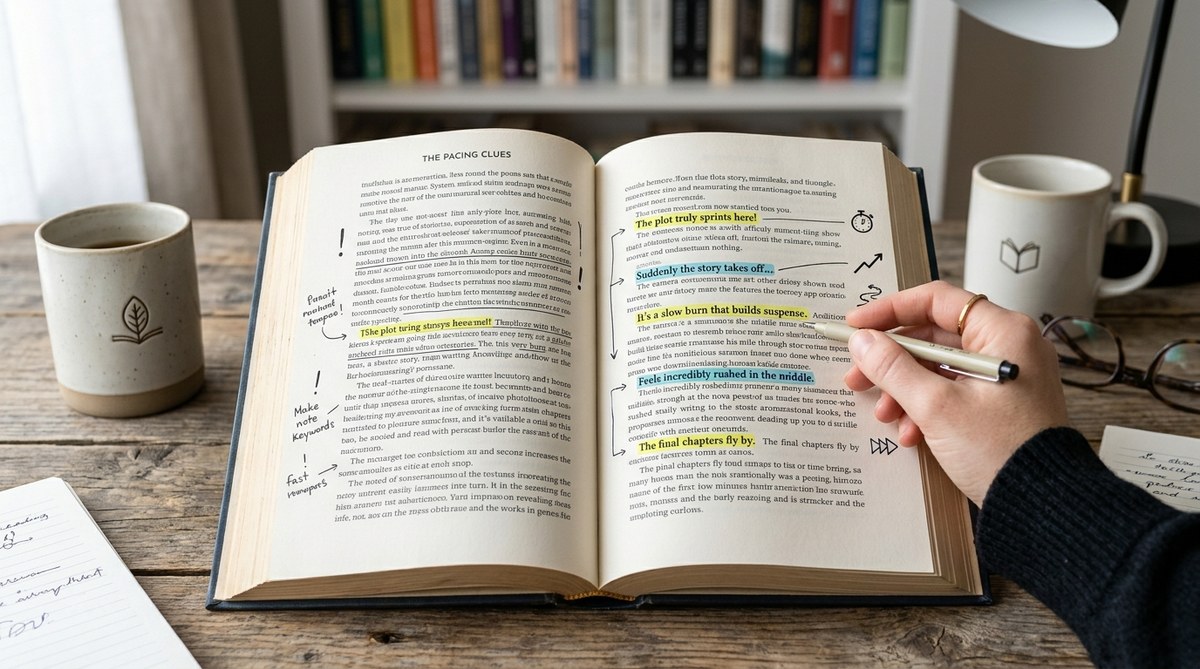
The Hidden Clues in Book Reviews That Reveal a Novel’s True Pacing
You have been burned before. A five-star review promised a “thrilling page-turner,” so you bought the book. Three weeks later, you are still stuck on chapter four, wondering if the plot will ever move. That frustration is real, and it is surprisingly common. The problem is not the book. The problem is that most reviews do not tell you the truth about pacing. They use vague words like “gripping” or “slow burn” without explaining what that means for your reading experience. But here is the good news: once you know what to look for, you can spot the real pacing of a novel in under a minute. You just need to learn how to read between the lines.
To tell if a book is fast paced from reviews, ignore star ratings and look for specific language. Words like “breathless,” “short chapters,” or “could not put it down” signal speed. Watch for complaints about “too much description” or “slow middle.” Compare what multiple reviewers say about the same section. That consistency reveals the truth.
Why Star Ratings Lie About Pacing
A four-star review does not mean the book moves at a good clip. Some readers give high marks because they love the characters, even if nothing happens for two hundred pages. Others rate a book down because they prefer literary fiction and found the plot too simple. The star rating reflects personal taste, not objective pacing.
Look at it this way: a reader who adores dense world-building might give five stars to a fantasy epic where the first hundred pages describe a single forest. A thriller fan would give that same book one star and call it “unreadable.” Neither review is wrong, but neither tells you how fast the story moves. You have to ignore the stars and focus on the words.
The Three Hidden Clues in Every Review
When you scan a review, you are looking for three specific types of information. These clues appear more often than you think, but they are easy to miss if you are not paying attention.
Clue one: time references. Does the reviewer mention how long it took them to finish the book? Phrases like “read it in one sitting,” “stayed up until 3 a.m.,” or “finished it on a flight” are gold. They tell you the reader felt compelled to keep going. On the flip side, “took me a week to get through” or “kept putting it down” suggest a slower pace.
Clue two: structural details. Reviewers often mention chapter length or scene structure without realizing it. Look for comments like “short chapters kept me turning pages” or “each chapter ended on a cliffhanger.” These are direct signals of fast pacing. If you see “long descriptive passages” or “the middle section dragged,” that is a red flag for a slower read.
Clue three: emotional urgency. Fast-paced books create a sense of momentum. Reviewers describe this as “breathless,” “heart-pounding,” or “I could not catch my breath.” If the review uses language about urgency, tension, or forward motion, the book likely moves at a clip. If the language is calm, reflective, or focused on atmosphere, expect a slower pace.
How to Scan Reviews Like a Detective
You do not need to read every review from start to finish. Use this bulleted list to scan for pacing signals in seconds.
- Look for the words “sitting,” “staying up,” or “binge.” These imply the reader could not stop.
- Check for complaints about “filler,” “slow parts,” or “too much backstory.”
- Notice if the reviewer says “the plot finally picks up after page 200.” That means the first half is slow.
- Search for “short chapters” or “cliffhanger endings.” These are structural clues.
- Watch for emotional words like “anxious,” “urgent,” or “racing.”
- Compare the first paragraph of the review to the last. If the reviewer started excited but ended bored, the pacing likely faded.
A Step-by-Step Process for Decoding Any Review
Follow this numbered process the next time you are deciding whether to commit to a novel. It takes less than two minutes and saves you hours of frustration.
-
Open the three-star reviews first. These are the most honest. Five-star reviews are often fan gushing. One-star reviews are often angry rants. Three-star reviewers are balanced and specific. They will tell you exactly what worked and what did not.
-
Copy a key phrase into your search. If the review says “the middle was slow,” search for that phrase across other reviews. If multiple people say the same thing, it is true. One person’s opinion is a fluke. Five people saying the same thing is a pattern.
-
Check the reviewer’s history. Click on the reviewer’s profile and look at what else they liked. If they gave five stars to other fast-paced thrillers and then gave this book three stars, the pacing is likely slower than average. If they usually read literary fiction and loved this book, it might be a slow burn that they appreciated.
-
Look for specific chapter counts. Some reviews mention page numbers or chapter counts. A book with 80 short chapters often feels faster than a book with 20 long chapters, even if the total page count is the same. That structural detail is a huge clue.
-
Read the last paragraph of the review. Many reviewers summarize their feelings at the end. If the final sentence says “worth the slow start” or “stick with it,” the pacing is uneven. If the ending says “I want more” or “I am sad it is over,” the pace likely worked well.
Common Pacing Phrases and What They Really Mean
Not all review language is straightforward. Some phrases sound positive but hide a slow pace. Others sound negative but actually signal a fast, intense read. This table breaks down the most common phrases and their true meaning.
| Phrase in the Review | What It Actually Means | Pace Signal |
|---|---|---|
| “A slow burn” | The story takes time to build. | Slow |
| “Beautifully descriptive” | Lots of scene-setting and detail. | Slow to medium |
| “Could not put it down” | The reader felt compelled to keep reading. | Fast |
| “The middle dragged” | The plot stalled after the setup. | Uneven |
| “Short, punchy chapters” | The structure creates momentum. | Fast |
| “I had to force myself to keep going” | The book felt like a chore. | Very slow |
| “The action starts on page one” | No warm-up. Immediate plot. | Very fast |
| “A character-driven story” | Focus is on internal growth, not plot events. | Slow to medium |
| “Each chapter ends on a cliffhanger” | Built-in suspense keeps you turning pages. | Fast |
| “The plot finally picks up after page 200” | The first half is slow. | Uneven |
The One Mistake Most Readers Make
The biggest error is trusting a single review. One person’s “fast-paced” is another person’s “rushed.” You need to compare at least three reviews to spot a consistent pattern. If two reviewers say the book is slow and one says it is fast, the truth is probably somewhere in the middle. But if all three mention that the chapters are short and the action is constant, you can trust that signal.
Another common mistake is confusing “fast” with “good.” A book can be fast-paced and still poorly written. Some thrillers move at a breakneck speed but have flat characters and weak dialogue. Pacing is just one factor. Use reviews to find books that match your preferred speed, but do not ignore other elements like writing quality and character development.
“The best indicator of pacing is not what the reviewer says about the book, but what they say about their own reading experience. If they mention time, energy, or emotional urgency, you are getting a real signal. If they only describe the plot, you are not.” — Anonymous librarian and book review analyst
How to Use This Method for Different Genres
Pacing expectations change by genre. A literary novel that moves slowly might be exactly what you want on a rainy Sunday. A thriller that moves slowly is a failure. Adjust your scanning based on what you are reading.
Thrillers and mysteries: Look for words like “twist,” “reveal,” “race,” and “suspense.” If reviewers say the ending was predictable, the pacing might have been too slow to maintain tension. If they say they guessed the twist early, the plot might have stalled in the middle.
Fantasy and sci-fi: These genres often have slower pacing because of world-building. Look for reviews that mention “action sequences” or “plot-driven.” If a reviewer says “the world-building is incredible but nothing happens,” expect a slow read.
Romance: Pacing in romance is often tied to the relationship development. Look for “slow burn” as a positive signal if you like tension. Look for “insta-love” if you prefer fast, direct romance.
Literary fiction: Slow pacing is often a feature, not a bug. Reviews will use words like “meditative,” “reflective,” or “atmospheric.” If you see “nothing happens,” the book is probably very slow. If you see “compelling from the first page,” it is unusually fast for the genre.
Young adult and middle grade: These books tend to be faster paced overall. Look for “action-packed” or “never a dull moment.” If a YA book has complaints about pacing, it is likely very slow.
Putting It All Together in Real Life
Imagine you are browsing for a new thriller. You see a book with a four-star average and a blurb that says “edge-of-your-seat suspense.” You open the reviews.
The first three-star review says: “The first hundred pages are slow. Lots of setup. But the last half is nonstop action.” The second three-star review says: “I almost gave up in the middle. The ending saved it.” The third review, a four-star, says: “Short chapters kept me going, but the pacing was uneven.”
You now know the truth. This book has a slow start and a fast finish. If you are willing to push through the first third, you will get the payoff. If you want something that grabs you from page one, skip this one.
That is the power of reading reviews like a detective. You are not guessing anymore. You are gathering evidence and making an informed choice.
Trust Your Own Reading Speed
After you have practiced this method a few times, you will develop a personal database of reviewers you trust. You will recognize the language of fast pacing and slow pacing without thinking about it. That is the goal. You want to spend less time deciding what to read and more time actually reading.
If you want to go deeper, check out our guide on how to judge a book’s length and pacing before you start reading. It covers physical clues like font size, chapter density, and page count that reviews cannot always capture.
You can also look at why book reviews are the secret to finding books you’ll actually love for a broader strategy on filtering your reading list.
The Next Time You Pick a Book
You now have a system. You know to ignore star ratings, scan for time references, compare multiple reviews, and watch for structural details. You know that “short chapters” is a better signal than “gripping.” You know that three-star reviews are your best friend.
The next time you see a book that looks promising, spend two minutes applying this method. Read the three-star reviews. Look for the hidden clues. Compare what people say about the middle section. By the time you finish those two minutes, you will know with confidence whether the book matches your preferred pace.
No more wasted weekends on books that never take off. No more frustration with vague reviews. You have the tools. Now go find your next page-turner.