What Your Favorite Book Genre Says About Your Personality (According to 2026 Research)
Your bookshelf might be more honest than your dating profile. The stories you reach for again and again reveal patterns in how your brain processes risk, emotion, and social dynamics. In 2026, researchers at the University of Texas published a large-scale study connecting reading preferences to personality frameworks like the Myers-Briggs Type Indicator and the Enneagram. Their findings confirm what many avid readers have suspected for years: your favorite book genre is a mirror for your inner world.
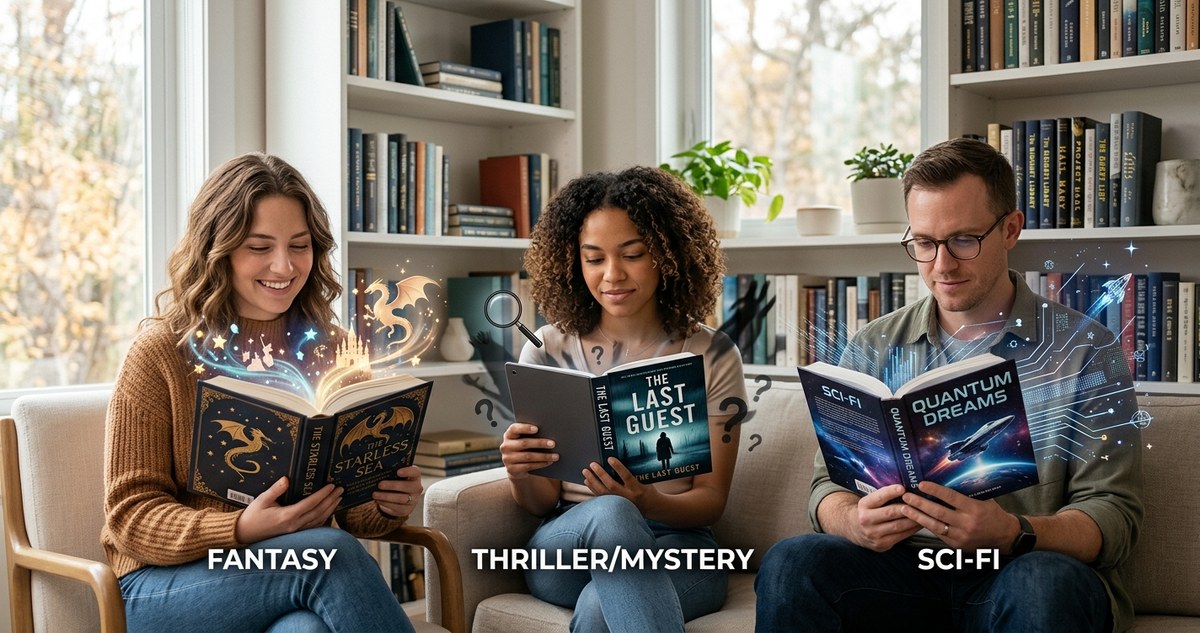
Your go-to book genre links directly to specific personality traits. Mystery readers tend to be logical and introverted. Romance lovers score high in empathy and extraversion. Science fiction fans show openness to new experiences. Fantasy readers lean toward creativity and emotional sensitivity. Understanding these connections can help you choose your next read more intentionally and even learn something about yourself.
How the 2026 Study Connected Book Genre Personality Traits
The UT study surveyed 4,200 regular readers and mapped their favorite genres against validated personality assessments. The lead researcher, Dr. Amara Singh, explained that reading preferences act as a kind of behavioral fingerprint. The genres we choose are not random. They align with how we process information, handle emotions, and relate to other people.
Here is a breakdown of the major findings.
Mystery and Thriller Readers
If you love a good whodunit, you likely score high in conscientiousness and low in neuroticism. You enjoy puzzles and patterns. You trust your own reasoning over group consensus. Many mystery readers identify as INTJ or INTP on the Myers-Briggs scale. You prefer structure but also crave mental stimulation. The satisfaction of solving the case before the detective does is part of the appeal.
Romance Readers
Romance readers consistently score high in agreeableness and extraversion. You value emotional connection and happy endings. You are optimistic about relationships. The 2026 study found that romance readers show higher levels of empathy than readers in any other genre. You likely identify as an ESFJ or ENFJ. You read to feel deeply and to experience love stories that affirm your belief in human connection.
Science Fiction and Fantasy Readers
These two genres share a common personality profile: high openness to experience and high imagination. Sci-fi readers tend to be more analytical and skeptical. Fantasy readers are more emotionally sensitive and idealistic. Both groups score low in conventionality. You are a dreamer who asks big questions. Many of you identify as an INFP or ENFP. You use stories to explore possible futures and alternate realities.
Literary Fiction Readers
Literary fiction attracts readers who score high in openness and introversion. You enjoy complex characters and ambiguous endings. You are introspective and often score as INFJ or INTJ. You read not for escape but for deeper understanding. You want to sit with difficult emotions and wrestle with moral questions.
Historical Fiction Readers
You are a bridge between the past and the present. Historical fiction readers score high in conscientiousness and agreeableness. You value tradition and learning. You likely identify as an ISFJ or ESFJ. You read to understand how people lived, loved, and struggled before you. You find comfort in continuity.
Horror Readers
Horror fans show a fascinating profile. You score high in openness but low in neuroticism. You are not easily frightened in real life. You enjoy the adrenaline of simulated fear. Many horror readers identify as ISTP or ESTP. You are curious about the dark edges of human experience. You read to test your own resilience.
A Practical Guide to Discovering Your Book Genre Personality
You can use this research to find books that match your temperament. Here is a simple process.
- Take a free personality test. Use a validated tool like the Big Five assessment or a Myers-Briggs style quiz. Write down your dominant traits.
- Review your recent reads. List the last five books you finished. Look for patterns. Are they all mysteries? Do they all feature strong romantic subplots?
- Cross-reference with the table below. Find your personality type and see which genres align.
- Try one book from a suggested genre. If you always read fantasy, try a literary novel. If you only read thrillers, pick up a romance.
- Reflect on how it felt. Did the new genre feel uncomfortable or refreshing? Your reaction tells you more about your reading identity.
Genre and Personality Matching Table
This table shows the strongest connections found in the 2026 research.
| Personality Trait (Big Five) | Likely Myers-Briggs Type | Matched Genre | Why It Fits |
|---|---|---|---|
| High openness, high conscientiousness | INTJ, INTP | Science Fiction | Enjoys complex systems and logical problem solving |
| High agreeableness, high extraversion | ESFJ, ENFJ | Romance | Values emotional harmony and human connection |
| High openness, low conscientiousness | INFP, ENFP | Fantasy | Imaginative, idealistic, and emotionally sensitive |
| Low neuroticism, high conscientiousness | ISTJ, ESTJ | Mystery | Loves order, patterns, and intellectual challenge |
| High openness, high neuroticism | INFJ, INTJ | Literary Fiction | Introspective and drawn to moral complexity |
| High conscientiousness, high agreeableness | ISFJ, ESFJ | Historical Fiction | Appreciates tradition, learning, and empathy |
| High openness, low neuroticism | ISTP, ESTP | Horror | Seeks controlled fear and novelty |
What Your Subgenre Choices Reveal
The research also looked at subgenres. These finer details can sharpen your understanding of your book genre personality.
- Cozy mystery readers tend to be more agreeable than hardboiled crime readers. You want the puzzle without the gore.
- Dark romance readers score higher in openness than traditional romance readers. You are willing to explore taboo emotions.
- Hard sci-fi readers (those who prefer physics and engineering) are more introverted than soft sci-fi readers (who prefer sociology and politics).
- High fantasy readers (epic quests, invented worlds) score higher in imagination than urban fantasy readers (magic in the real world).
“Your reading preferences are not a cage. They are a starting point. The goal is not to stay inside your comfort zone. It is to understand why you feel comfortable there, so you can choose when to leave.” Dr. Amara Singh, lead researcher.
How to Use This Knowledge for Better Reading Choices
You do not have to abandon your favorite genre. You can use your book genre personality profile to make smarter choices about what to read next.
- If you are a mystery reader who wants to build empathy, try a character-driven literary novel. The slower pace will stretch your patience and reward your analytical side.
- If you are a romance reader who wants to sharpen logic, try a locked-room mystery. The emotional distance may feel strange at first, but the puzzle will engage your mind.
- If you are a sci-fi reader who wants to connect emotionally, try a romance or a family drama. The focus on relationships will challenge your usual preference for ideas over feelings.
- If you are a fantasy reader who wants to ground yourself, try historical fiction. The real-world setting will feel limiting, but the human stories will resonate.
For more tailored recommendations, check out our guide on how to choose the perfect book for every age and interest. You can also browse our top reading lists to inspire a lifelong love of books for all ages.
The Limits of the Research
No personality test is perfect. The 2026 study is a snapshot, not a verdict. Your book genre personality can change over time. You might love fantasy in your twenties and switch to literary fiction in your forties. That is normal. Life experience reshapes what you need from stories.
Also, many people read across multiple genres. The study asked participants to name their single favorite genre. If you love both mystery and romance, you are not broken. You are versatile. Your personality likely includes traits from both profiles.
Common Mistakes When Interpreting Your Book Genre Personality
Avoid these traps.
- Assuming one genre defines you completely. You are more complex than any single label.
- Ignoring why you read. Do you read for escape, for learning, or for emotional catharsis? Your motivation matters as much as the genre.
- Forcing yourself into a genre that does not fit. If you hate every literary novel you try, do not force it. Your personality is valid even if it does not match the research.
- Using the results to judge others. A romance reader is not less intelligent than a literary fiction reader. Different personalities value different things.
For more on how to evaluate reading material, read our article on 5 signs a book review is worth your time (and 3 that aren’t).
What Your Favorite Book Genre Says About Your Next Chapter
Your reading identity is not fixed. It evolves as you do. The 2026 research gives you a map, not a destination. Use it to understand yourself better. Use it to find books that challenge you and books that comfort you. Use it to start conversations with other readers.
The next time someone asks what you are reading, you can tell them more than just the title. You can tell them what it says about you. And you can ask them the same question. That is how readers connect, not through algorithms but through shared stories and self-awareness.