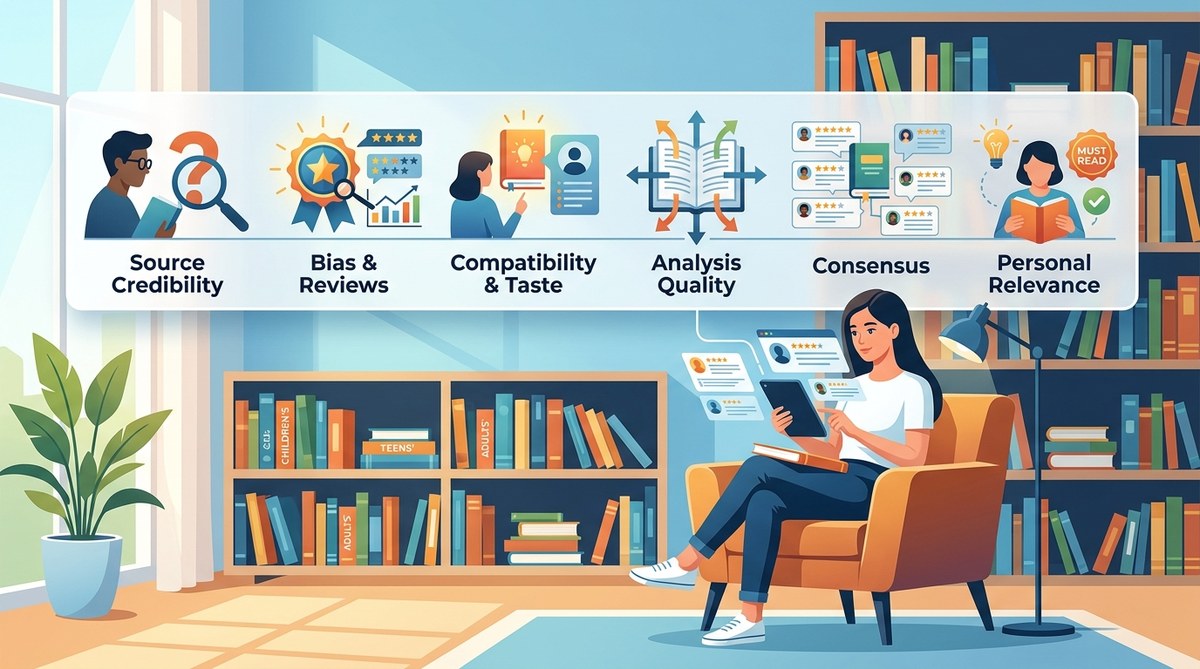
6 Questions to Ask Before You Let a Book Review Influence Your Purchase
You have been burned before. You read a glowing five star review, ordered the book, and then spent the weekend forcing yourself through a story that felt like a chore. That feeling of regret is common, but it is also avoidable. The secret is not to stop reading reviews. The secret is learning how to read them with a critical eye.
Reviews are tools. Like any tool, they work best when you know how to use them. A single review is just one person’s opinion. But a handful of reviews, read correctly, can tell you almost everything you need to know about whether a book belongs on your shelf. This guide walks you through the exact questions to ask before buying a book, so you can spend less time returning duds and more time getting lost in stories you love.
Before you buy, check the reviewer’s taste, not just their rating. Look for patterns across multiple reviews, ignore vague praise, and always read the negative reviews first. They reveal the book’s true flaws and whether those flaws will ruin your reading experience. Spend five minutes reading critically, save yourself five hours of regret.
Why Your Last Book Purchase Let You Down
Think about the last book that disappointed you. Did the cover promise a thriller but deliver a slow burn romance? Did everyone rave about the prose while you found it unreadable? The problem was not the book. The problem was a mismatch between what the book offers and what you actually wanted.
Reading is deeply personal. A book that changes your best friend’s life might bore you to tears. That is not a failure on your part. It simply means you have different tastes. The challenge is that most reviews are written by people who loved the book, and they are not always good at explaining why. They say things like “amazing” and “unputdownable” without ever telling you what that means.
To avoid this trap, you need to ask better questions before you spend your money. These questions shift your focus from the rating itself to the person giving it. Once you understand the reviewer, you can finally understand the book.
The 6 Questions to Ask Before Buying a Book
These six questions form the backbone of smart book shopping. They help you filter through the noise and find the signal.
1. Does This Reviewer Share My Reading Taste?
This is the single most important question. You need a reference point. Look at the reviewer’s other favorite books. Do they love dense literary fiction? Do they prefer fast paced thrillers? Do they only read romance? If the reviewer loves the same books you love, their negative review carries weight. If they love books you cannot stand, their positive review might not mean much to you.
Take a moment to click on their profile. Look at their recent reads. Give them a rating from one to five based on how similar their taste is to yours. This one step takes thirty seconds and saves you hours of reading time.
2. What Does the Review Actually Say?
A review that says “this book was so good, you have to read it” tells you nothing. Neither does a one star review that simply says “I hated this.” You are looking for specific details. What exactly did they love? What exactly did they hate? Did they mention the pacing? The character development? The plot twists?
Specificity is a sign of a thoughtful review. It means the reviewer took the time to analyze why the book worked or failed. Vague praise is often a sign of a shallow reader. It can also be a sign of a fake review, especially on self published books. Look for reviews that mention concrete scenes, character names, or plot points. Those details are hard to fake.
3. Is the Reviewer Being Objective or Emotional?
Some reviewers rate books based on how the book made them feel. That is valid, but it is not always helpful. If a reviewer is angry because the author killed their favorite character, they might give a one star review that is really about their feelings, not the book’s quality. Conversely, a reviewer who is in the honeymoon phase with the genre might give everything five stars.
Look for emotional language that signals a bias. Words like “disgusting” or “beautiful” are subjective. Instead, focus on the facts. Did the plot make sense? Were the characters consistent? Did the ending satisfy? A good reviewer separates their emotional reaction from the technical execution of the book.
4. What Do the Negative Reviews Say?
This might feel counterintuitive, but you should read the negative reviews first. They are often more honest. A glowing review can be written by a friend, a fan, or someone who just finished the book and is riding the high. A negative review usually comes from someone who had a specific problem, and that problem might be something you care about.
Look for patterns in the negative reviews. If multiple people mention that the ending felt rushed, you can bet the ending is rushed. If several reviewers say the main character is unlikable, that is a red flag. Once you identify the common complaints, ask yourself if those are deal breakers for you. Maybe you do not care about a rushed ending if the journey was fun. Maybe an unlikable protagonist is exactly what you want to read about.
5. Who Is the Reviewer?
Not all reviewers are created equal. A reviewer who has read 10,000 books has a different perspective than someone who just started reading last month. A reviewer who specializes in fantasy romance knows that subgenre better than a generalist. Check the reviewer’s bio. Do they have a track record of thoughtful reviews? Do they seem to have an agenda?
Also, be wary of reviewers who are authors themselves. They might be friends with the author of the book you are considering. They might be competing with them. They might be reviewing the author’s previous work and carrying that baggage forward. This is not to say author reviews are always biased, but you should take them with a grain of salt.
6. How Does This Book Compare to Others in Its Genre?
Every genre has its own conventions. A romance novel needs a happy ending. A thriller needs a satisfying twist. A literary novel needs beautiful prose. When you read a review, ask yourself if the reviewer is comparing this book to others in its genre or holding it to an impossible standard.
A reviewer who says “this book is not as good as The Count of Monte Cristo” might be missing the point. The book might be a light, fun adventure that does not aspire to be a classic. Read reviews with the genre in mind. A four star review in a niche genre might be more valuable than a five star review of a popular book that is outside your usual reading lane.
A Practical Process for Reading Reviews
Now that you know the questions, you need a process. Follow these steps every time you are considering a new book.
- Start with the one star reviews. Read the top three most helpful ones. Look for patterns.
- Skim the three star reviews. These are the most balanced. They often mention both pros and cons.
- Read the five star reviews. Look for specific details that match your reading taste.
- Check the reviewer’s other books. Spend one minute looking at their recent reads to see if their taste aligns with yours.
- Make your decision. Weigh the pros and cons. Trust your gut.
A Quick Reference Table for Evaluating Reviews
Use this table as a cheat sheet when you are scrolling through reviews.
| What You Read | What It Means | What To Do |
|---|---|---|
| “I loved it, so good!” | Vague praise, no substance | Keep looking for details |
| “The pacing lagged in the middle third.” | Specific critique about structure | Decide if you mind a slow middle |
| “The main character was insufferable.” | A common complaint, likely true | Check if other reviewers agree |
| “This book changed my life.” | High praise, but subjective | Look for the “why” behind the emotion |
| “The author is a genius.” | Possibly biased or a fan | Look for a more objective review |
| “The plot twist was predictable.” | A common complaint for thrillers | Decide if you read for the twist or the journey |
| “I could not put it down.” | High praise, but vague | Look for details about the story structure |
When to Ignore the Reviews Completely
Sometimes, you should ignore the reviews altogether. If you are a fan of a particular author and you have loved everything they have written, you can probably buy their new book without reading a single review. You know their style. You know their voice. You know what to expect.
The same goes for a book that calls to you from the shelf. Sometimes you need to trust your instinct. A book that feels right, even if the reviews are mixed, might be exactly what you need. Reading is an adventure. Part of the fun is taking a chance on something new.
However, if you are on a budget, or if you are buying a book as a gift, you should always do your homework. There is nothing worse than giving someone a book they will never read. If you are shopping for a child, you need to be even more careful. A bad book can turn a young reader off reading for a long time. Check out our top kids books to spark imagination and love for reading for vetted recommendations.
How to Use Reviews to Find Hidden Gems
Reviews are not just for avoiding bad books. They are also a powerful tool for finding great ones. When you find a reviewer who shares your taste, read their entire review history. You will discover books you have never heard of. You will find hidden gems that do not get the same marketing budget as the big releases.
Look for reviewers who read widely. They will expose you to new genres and authors you might have overlooked. This is how you grow as a reader. This is how you find books that feel like they were written just for you. You can also use reviews to build a better reading list. When you find a review that praises a book for specific elements you love, add it to your list.
The Real Cost of a Bad Review
A bad review costs you more than just the price of the book. It costs you time. It costs you the chance to read a different book that you might have loved. It costs you the emotional energy of being disappointed. In 2026, with so many books competing for your attention, you cannot afford to waste your time on books that are not right for you.
This is why it is so important to ask the right questions before you buy. A little bit of effort upfront saves you a lot of regret later. You can also learn from your own past mistakes. Think about the last book you did not finish. What made you stop reading? Use that knowledge to refine your review reading strategy. If you found the characters flat, look for reviews that mention strong character development. If the plot was too slow, look for reviews that mention a fast pace.
A Note on Spoilers and the Modern Review
In the age of social media, spoilers are everywhere. A careless reviewer can ruin a major plot twist in a single sentence. Be careful when you are reading reviews on social media platforms. The review might be good, but the spoiler is not worth it. If you are sensitive to spoilers, stick to review sites that have spoiler tags, or read the review only after you have finished the book.
You should also be aware of the “review bombing” phenomenon. Sometimes, a book gets a wave of negative reviews for reasons that have nothing to do with the story. The author might have said something controversial. The publisher might have done something to anger a particular group. If you see a sudden influx of one star reviews, check the dates. If they all happened on the same day, they might not be trustworthy.
Trusting Your Own Reading Instincts
At the end of the day, you are the only one who can decide if a book is right for you. Reviews are a guide, not a rulebook. They can help you make an informed decision, but they should never replace your own judgment. If a book sounds interesting to you, read it. If it sounds boring, skip it. The more you read, the better you will get at knowing what you like.
Do not be afraid to abandon a book you are not enjoying. There are too many good books out there to waste your time on one that is not working for you. Put it down. Pick up another one. Your reading time is precious. Spend it on books that bring you joy.
The Best Time to Read a Review Is Before You Buy
This sounds obvious, but you would be surprised how many people buy a book on impulse and then read the reviews on the way home. The best time to read the reviews is before you click “add to cart.” That is when the information is most useful. That is when it can save you money.
This is especially important for parents. When you are buying books for your kids, you need to be sure you are getting a quality book that will hold their attention. A bad book can turn a reluctant reader into a non reader. Before you buy a book for your child, read the reviews. Look for reviews from other parents. They will tell you if the book is age appropriate and if it is engaging. Our guide on how to identify trustworthy book reviews for your child’s reading journey can help you get started.
Turning Reviews into a Reading Superpower
Once you master the art of reading reviews, you will wonder how you ever managed without it. You will make fewer mistakes. You will discover better books. You will become a more confident reader. This is not about being a snob. It is about being smart with your time and your money.
The next time you are scrolling through a book page, do not just look at the stars. Look at the people behind the stars. Ask yourself the questions we have talked about. Do they share your taste? Are they specific? Are they emotional? Are they comparing apples to oranges? The answers to these questions will tell you everything you need to know.
How to Build a Better Reading List
A good reading list is built on a foundation of good reviews. Start by finding two or three reviewers whose taste you trust. Follow them. Read their weekly roundups. Then, branch out. Look at the “readers also enjoyed” section on your favorite books. Cross reference those suggestions with your trusted reviewers.
You can also use reviews to challenge yourself. If you only read one genre, look for a highly reviewed book in a different genre. You might be surprised by what you find. This is how you grow as a reader. This is how you keep the magic of reading alive. If you are looking for a place to start, check out these essential reading tips to help kids develop a love for books or find your next favorite read with our must-read book reviews for adult fiction enthusiasts.
The One Question That Always Works
There is one question that cuts through all the noise. It is the question you should ask yourself after you read a handful of reviews. That question is simple: “Would I rather read this book or the review?” If the review is more interesting than the book sounds, that is a bad sign. If the review makes you want to know what happens next, that is a good sign.
This question works because it forces you to focus on the story. It forces you to think about whether the book is actually for you. It is a gut check. And your gut is usually right.
A Final Word on Finding Your Next Great Read
Reading reviews should feel like getting advice from a smart friend. It should be helpful, not overwhelming. It should guide you, not dictate to you. The goal is not to find a book that everyone loves. The goal is to find a book that you love. And the only way to do that is to understand what you like and to find reviewers who like the same things.
So, the next time you are standing in a bookstore or scrolling online, take a breath. Do not just grab the first book that has a pretty cover. Do not just buy the one that is on the bestseller list. Take a few minutes to read the reviews. Ask the questions. Do the work. Your future self will thank you for it. And if you are ever in doubt, remember the wise words of a seasoned reader: “A review is just one person’s map. You are the one who has to walk the path.” Happy reading.
Now, go find a book that makes you lose track of time. You have the tools. You have the questions. Trust the process, and trust yourself.